When you get pre-approved, the number everyone talks about is the mortgage payment. It's the wrong number to budget around.
Owning a home costs more than the loan every single month — property tax, insurance, and maintenance ride along whether you think about them or not. On a typical 2026 purchase, the mortgage principal and interest is only about 70% of what the home actually costs you each month. The rest is real money, and most first-time buyers don't see it until it's already leaving their account.
The short version:
- Budget the all-in cost, not the mortgage payment. On a $500,000 home with 20% down, the mortgage is about $2,661/month — but the true cost runs about $3,778/month once you add property tax, insurance, and upkeep. That's $1,117 more every month.
- The premium is remarkably stable. Across $300k, $500k, and $750k homes, the all-in cost lands near 1.42× the mortgage payment. A useful rule of thumb: take your principal-and-interest payment and add about 40%.
- A lot of what you spend, you never get back. Over a 7-year stay, mortgage interest, property tax, insurance, maintenance, and the costs of buying and selling add up to more than the equity you build.
- Don't count on the tax break to bail you out. With today's standard deduction, many buyers get little or nothing from the mortgage-interest deduction.
What "True Cost" Actually Means
Mortgage lenders quote you principal and interest — the part of the payment that pays back the loan. But owning a home comes with four recurring costs, often abbreviated PITI + maintenance:
- Principal & Interest — the mortgage payment itself.
- Taxes — property tax, billed by your county, usually around 1.1% of the home's value per year nationally (but 0.3% to over 2% depending on where you live).
- Insurance — homeowners insurance, roughly 0.4% of the home's value per year.
- Maintenance & upkeep — repairs, replacements, HOA dues, landscaping. A common planning figure is about 1% of the home's value per year.
The mortgage is fixed. The other three are not — they rise over time, and two of them (taxes and insurance) keep coming after the mortgage is paid off. That's the part "just compare it to my rent" math misses.
The mortgage payment tells you what you owe the bank. The all-in cost tells you what owning the house does to your budget.
Why It Matters
The gap between the mortgage payment and the true cost is exactly where new homeowners get caught. You qualify for a payment, you budget for that payment, and then property tax, insurance, and the first surprise repair arrive on top. Knowing the all-in number up front does three things:
- It tells you what the house really does to your monthly budget, so you don't end up "house poor."
- It lets you compare homes honestly — a cheaper house in a high-tax county can cost more per month than a pricier one in a low-tax county.
- It sets a realistic savings target before you buy, including a cushion for the costs that don't show up on a mortgage statement.
If you are still figuring out the cash you need before closing, pair this with How Much Money Do You Actually Need to Buy a House?, which separates the down payment from closing costs, moving/setup money, and post-closing reserves.
A Real 2026 Scenario
Let's use concrete numbers you can drop straight into the calculator — a mid-priced home with a round 7% mortgage-rate stress test. Freddie Mac's Primary Mortgage Market Survey is the standard place to check the current weekly 30-year fixed rate; if the market rate is lower or higher when you read this, change that one input first.
| Input | Value |
|---|---|
| Home price | $500,000 |
| Down payment | 20% ($100,000) |
| Mortgage | 30-year fixed at 7% |
| Property tax | ~1.1% of value / year |
| Homeowners insurance | ~0.4% of value / year |
| Maintenance & upkeep | ~1% of value / year |
| Home appreciation | 3% / year |
Open the prefilled $500,000 home-cost scenario to start with the assumptions above, then map the home price, taxes, insurance, maintenance, and time horizon to your situation.
Here's how the first-year monthly cost breaks down:
| Monthly cost | Amount |
|---|---|
| Principal & interest | $2,661 |
| Property tax | $458 |
| Homeowners insurance | $167 |
| Maintenance & upkeep | $492 |
| True all-in monthly cost | $3,778 |
The mortgage payment is $2,661. The true cost is $3,778 — about $1,117 more per month, or roughly 42% on top of the loan payment.
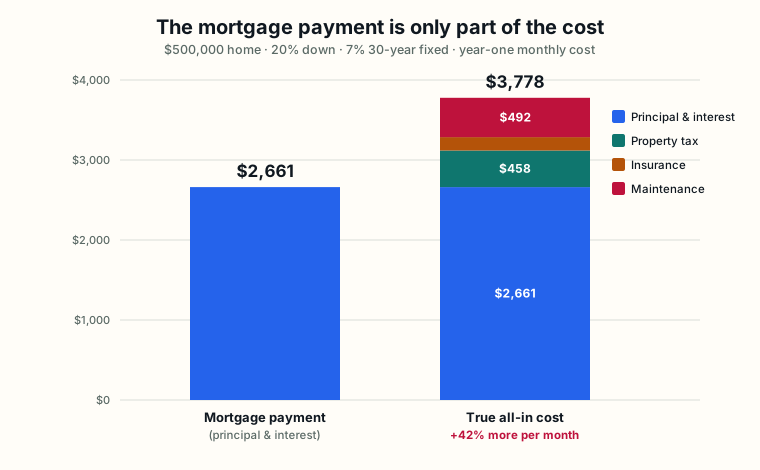
The mortgage payment most people budget around (left) versus what the home actually costs each month (right). The extra $1,117 isn't optional — it's property tax, insurance, and the upkeep every home eventually needs.
The 40% rule of thumb
The most useful takeaway here is how stable that premium is. Run the same 20%-down, 7% scenario at three price points and the all-in cost lands near 1.42× the mortgage payment every time:
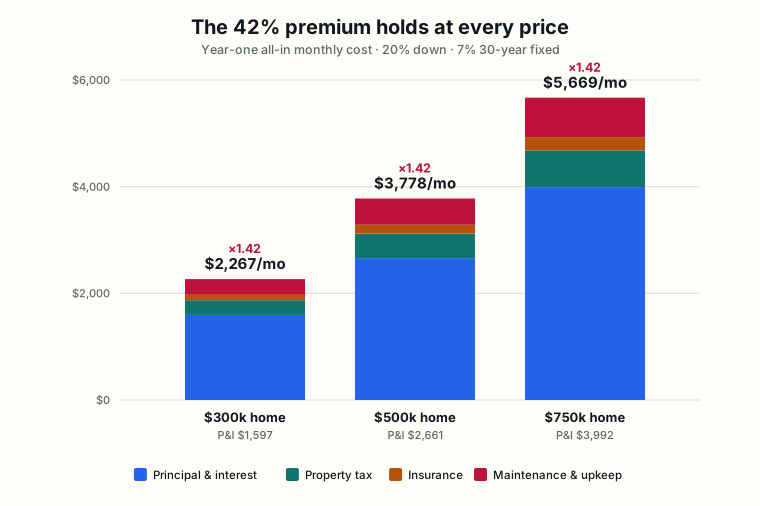
Same down payment, same rate — only the price changes. The all-in cost stays close to 1.42× the mortgage payment across the board, because property tax, insurance, and maintenance all scale with the home's value.
So a quick gut check before you fall in love with a listing: take the principal-and-interest payment a mortgage calculator gives you and add about 40%. That's much closer to what the home will really cost than the loan payment alone. (Your local property-tax rate is the biggest reason your number will differ — see "What changes the answer" below.)
The Costs That Don't Show Up in the Payment
Two more line items deserve special attention because they surprise people in opposite directions.
PMI: the cost of a smaller down payment
If you put down less than 20%, lenders charge private mortgage insurance (PMI) — protection for them, paid by you. On the same $500,000 home with 10% down and a 0.5% PMI rate, PMI adds about $188/month, pushing the all-in cost from $3,778 to roughly $4,298. PMI isn't forever — it cancels automatically once your loan balance falls to 78% of the original price, which in this scenario takes until about year 9.6. But that's years of an extra couple thousand dollars annually.
For the full down-payment tradeoff, see PMI Explained: What a Smaller Down Payment Really Costs.
The tax break that often isn't
Many buyers assume the mortgage-interest deduction will quietly lower their cost. Often it doesn't do much. To benefit, your itemized deductions have to exceed the standard deduction. For tax year 2026, the IRS lists the married-filing-jointly standard deduction at $32,200 in its tax inflation adjustments. In our scenario, year-one mortgage interest is about $27,900, and the property tax estimate adds about $5,500 before considering any other itemized deductions. That is only about $1,200 above the standard deduction, or roughly $300 of federal tax savings at a 24% marginal rate.
The mortgage-interest rules also have limits. IRS Publication 936 explains the home mortgage interest deduction and the acquisition-debt limits that apply to many recent mortgages. The practical point for budgeting is simpler: count the payment first, then treat any tax benefit as a bonus after you know it actually applies.
A higher down payment, a lower rate, or a smaller loan can push itemized deductions below the standard deduction entirely. Treat any tax break as a bonus, not a reason the house is affordable.
The 7-Year Reality: What You Get Back vs. What's Gone
Some of what you pay builds equity — money you get back when you sell. A lot of it doesn't. Here's where the money goes over a 7-year stay in the base scenario, with the home sold at the end after rising 3% a year:
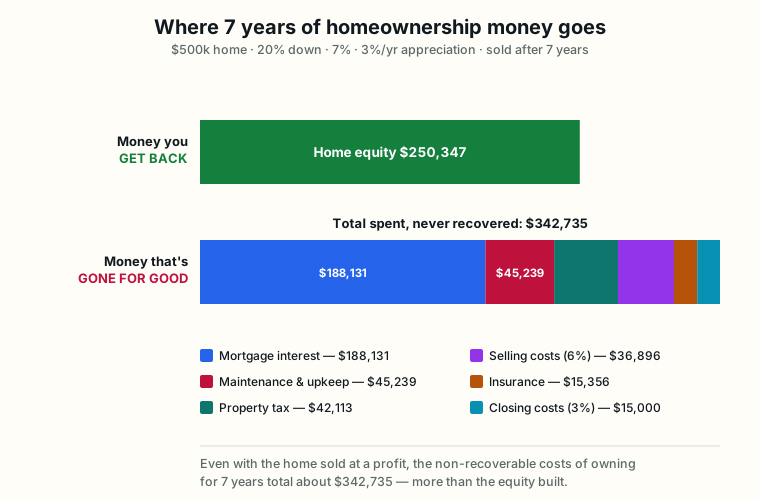
Over seven years you build about $250,000 in equity — but you also spend about $343,000 that you never recover: interest, taxes, insurance, upkeep, and the costs of getting in and out. Owning builds wealth, but it is not "free" just because you sell at a profit.
This isn't an argument against buying — building $250,000 in equity is real, and a fixed mortgage is a powerful hedge against rising rents. It's an argument for clear eyes. The "I'm building equity instead of throwing money away on rent" story is only half true: a meaningful share of every homeowner's payment is also gone for good.
| Over 7 years | Amount |
|---|---|
| Equity you get back | ~$250,000 |
| Mortgage interest | ~$188,000 |
| Maintenance & upkeep | ~$45,000 |
| Property tax | ~$42,000 |
| Selling costs (6%) | ~$37,000 |
| Insurance | ~$15,000 |
| Closing costs (3%) | ~$15,000 |
What Changes the Answer
Your number will differ from the scenario above. These are the levers that move it most:
- Your local property-tax rate. This is the single biggest source of variation. At 0.3% (parts of the South and West) property tax barely registers; at 2.2% (parts of the Northeast and Midwest) it can rival a car payment. The same house can cost hundreds more per month depending only on the county line.
- Down payment size. Under 20% adds PMI; a bigger down payment lowers both the loan payment and the PMI, but ties up cash you could invest elsewhere.
- Mortgage rate. Each point of rate changes the principal-and-interest payment meaningfully. At 7% our $400k loan costs $2,661/month; the rate is the lever you can sometimes shop or refinance.
- The age and type of home. Older homes and single-family houses tend to run higher maintenance than new builds or condos — though condos add HOA dues that can dwarf the savings.
- Insurance market. In high-risk areas (wildfire, hurricane, flood), homeowners insurance can run several times the 0.4% national average — and it has been rising fast.
Common Mistakes
- Budgeting around the mortgage payment. It's roughly 70% of the real monthly cost. Add taxes, insurance, and maintenance before you decide what you can afford.
- Forgetting maintenance because it's irregular. A roof or HVAC system doesn't bill you monthly, but averaged out it's real money — plan for about 1% of the home's value per year.
- Assuming the tax deduction lowers your cost. With the high standard deduction and the SALT cap, many buyers get only a small benefit, or $0. Check before you count on it.
- Treating "I'll sell at a profit" as "owning was free." Interest, taxes, insurance, upkeep, and transaction costs are gone whether the home appreciates or not.
- Ignoring the costs that outlive the mortgage. Property tax, insurance, and maintenance never stop — and they keep rising — long after the loan is paid off.
Make the Example Your Own
Start from the article assumptions, then test these versions:
- Set the property tax to your county's actual rate. This moves your number more than almost anything else.
- Drop the down payment to 10% to see PMI appear and how long it sticks around.
- Turn on the tax modeling (Detailed mode) to check whether the mortgage-interest deduction does anything for you at all.
- Shorten the years-staying dial to 3 to see how buying and selling costs dominate a short stay.
If you're still saving for the down payment, plan the runway with a Savings Plan first. If the full cash target is still fuzzy, use How Much Money Do You Actually Need to Buy a House? to separate closing-day cash from post-closing reserves. And if you're weighing whether to buy at all, run the Rent vs. Buy calculator to find your break-even year.
A Note on Assumptions
Every dollar figure in this article comes from the same month-by-month model the calculator uses, with the inputs listed above and national-average rates for property tax (1.1%), insurance (0.4%), and maintenance (~1%). Your real costs depend heavily on your location, the specific home, and the insurance market. Maintenance in particular arrives in lumps, not smooth monthly amounts. Treat these numbers as a well-reasoned starting point, then make them yours by entering your real figures.
Sources
- Freddie Mac: Primary Mortgage Market Survey
- IRS: Tax Inflation Adjustments for Tax Year 2026
- IRS Publication 936: Home Mortgage Interest Deduction
This article is educational and not personalized financial, tax, or investment advice.
Related
- Home Buyer calculator — see your full all-in cost and equity
- Rent vs. Buy calculator — find your break-even year
- Savings Plan — save for the down payment and closing costs
More Home Affordability Calculator articles
Practical examples that connect the calculator to real planning decisions.
PMI Explained: What a Smaller Down Payment Really Costs
See what PMI really costs in a 2026 home-buying scenario, when it can drop off, and how 10%, 15%, and 20% down payments change the plan.
How Much Money Do You Actually Need to Buy a House?
Estimate cash to close, reserves, moving costs, and repairs with a $500,000 home-buying example for 2026.