PMI is not a penalty for being bad with money. It is the price of buying with less cash up front.
That can be a reasonable tradeoff. A smaller down payment can move the purchase date closer, preserve an emergency fund, or help you avoid waiting years while home prices and rents keep moving. But PMI is also easy to underestimate because it looks like one more line in the monthly payment instead of a decision with a timeline and a total cost.
For a $500,000 home at a 7% mortgage rate, a buyer putting 10% down needs $50,000 less at closing than a buyer putting 20% down. In this calculator example, the tradeoff is about $188 of first-month PMI, an all-in first-month cost near $4,298, and roughly $20,100 of PMI before it drops off around month 115.
The short version:
- PMI protects the lender, not the buyer. The Consumer Financial Protection Bureau explains that private mortgage insurance is commonly required on conventional loans when the down payment is less than 20%.
- A smaller down payment buys time, not a cheaper house. The loan is larger, the principal-and-interest payment is higher, and PMI sits on top.
- PMI is usually temporary, but temporary can still mean years. In this example, 10% down keeps PMI on the plan for about 9.5 years under the calculator's original-price cancellation rule.
- The right question is not only "can I avoid PMI?" It is whether paying PMI is better than delaying the purchase, draining cash, or buying a weaker home just to hit 20% down.
What PMI Actually Is
Private mortgage insurance (PMI) is insurance for the lender on a conventional mortgage. You pay for it when the lender sees the loan as riskier, usually because your down payment is below 20% of the purchase price.
It does not pay your mortgage if you lose your job. It does not protect your equity. It protects the lender if you stop making payments and the home sale does not fully cover the loan.
That makes PMI frustrating, but not mysterious. It is part of the cost of using more borrowed money and less cash.
The important planning question is:
Does paying PMI for a while leave your overall plan stronger than waiting longer or emptying your cash reserves to avoid it?
A Real 2026 Scenario
Let's use the same home price as the other Home Buyer articles so the tradeoff is easy to compare.
| Input | Value |
|---|---|
| Home price | $500,000 |
| Mortgage rate | 7% |
| Mortgage term | 30 years |
| Property tax | About 1.1% of home value per year |
| Homeowners insurance | About 0.4% of home value per year |
| Maintenance and other ownership costs | About 1% of home value per year |
| PMI rate used for illustration | 0.5% of loan balance per year |
| PMI cancellation mode | Original-price basis |
Open the prefilled 10% down PMI scenario to start with the assumptions above, then map the home price, down payment, PMI quote, mortgage rate, and cancellation mode to your situation.
Here is what changes when the buyer tests three down-payment paths.
| Down payment | Cash down | Starting loan | First-month all-in cost | First-month PMI | PMI drop month | Approx. PMI paid |
|---|---|---|---|---|---|---|
| 10% | $50,000 | $450,000 | $4,298 | $188 | Month 115 | $20,100 |
| 15% | $75,000 | $425,000 | $4,122 | $177 | Month 80 | $13,500 |
| 20% | $100,000 | $400,000 | $3,778 | $0 | Not applicable | $0 |
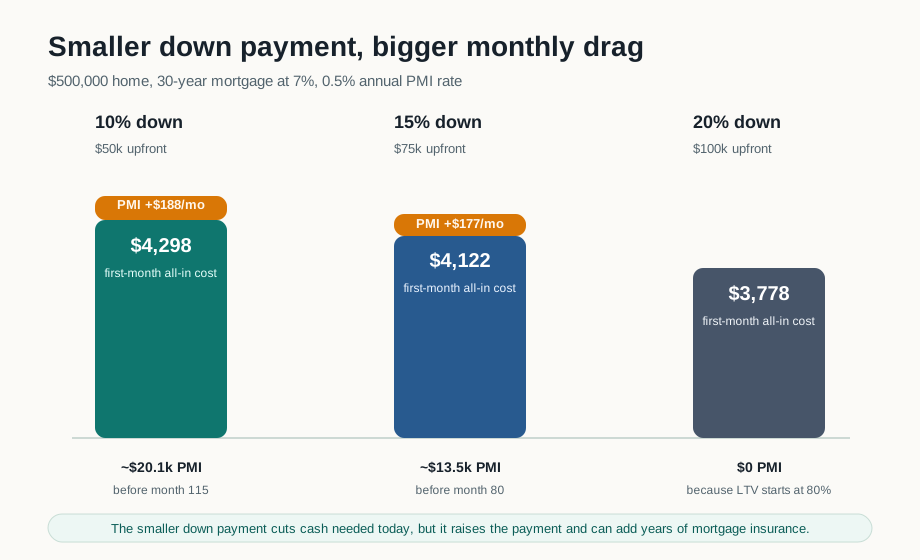
A smaller down payment reduces the cash needed today. It also creates a larger loan, a higher monthly payment, and a PMI bill that can last for years.
The Tradeoff In Plain English
The 10% down buyer keeps $50,000 more cash than the 20% down buyer at purchase. That can be valuable. It might cover closing costs, moving costs, repairs, or the emergency fund that makes homeownership feel safer.
But the 10% down buyer is not getting the same house for the same monthly cost. In this example:
- The loan starts $50,000 higher.
- The principal-and-interest payment is about $333/month higher than the 20% down version.
- PMI adds about $188 in month one.
- The total first-month all-in cost is about $520/month higher.
That is why PMI should be tested inside the full ownership budget, not judged by one rule of thumb. If the higher all-in payment still fits, PMI may be a bridge. If the payment only works before PMI, the purchase is probably too tight.
For the full cash target before buying, read How Much Money Do You Actually Need to Buy a House?. For the recurring monthly budget, pair this with The True Cost of Owning a Home.
When PMI Can Go Away
PMI is not supposed to stay forever on a standard amortizing conventional loan, but the exact path depends on your loan documents, payment status, investor rules, and servicer process.
Two rules matter for planning:
- You may be able to request cancellation around 80% loan-to-value. The CFPB says borrowers generally have the right to ask the servicer to cancel PMI when the principal balance is scheduled to reach 80% of the home's original value, assuming the required conditions are met.
- Automatic termination is generally tied to 78% of original value. The CFPB explains that servicers generally must automatically terminate PMI when the scheduled principal balance reaches 78% of the home's original value, if the borrower is current.
The Home Buyer calculator's default PMI cancellation mode uses the original purchase price. In the 10% down scenario, the loan starts at $450,000. The 78% threshold on a $500,000 original value is $390,000. At a 7% 30-year mortgage rate, the scheduled loan balance crosses that threshold around month 115.
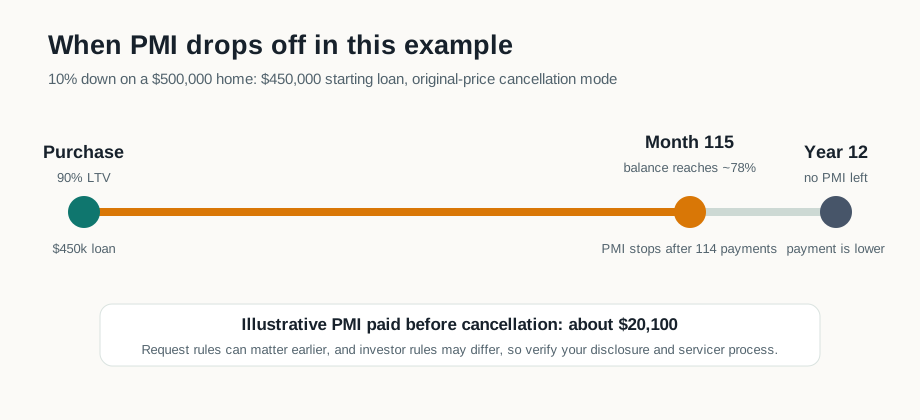
In this example, PMI lasts a long time because early mortgage payments are mostly interest. The balance moves, but slowly.
Is PMI Worth It?
PMI can be worth it when it solves a real constraint without making the monthly plan fragile.
It may be reasonable when:
- You can afford the all-in monthly payment with PMI included.
- Keeping more cash prevents you from draining your emergency fund.
- Waiting for 20% down would delay the purchase for years.
- You have a credible path to refinance, recast, request cancellation, or pay extra principal later.
- The home still works under a stress test with higher taxes, insurance, repairs, or a shorter stay.
PMI is a warning sign when:
- The payment only works if you ignore taxes, insurance, maintenance, or PMI.
- You would have no reserve after closing.
- You are buying mainly because you fear missing out.
- You plan to sell before the PMI has much chance to disappear.
- The house is already at the top of your affordability range.
The hard part is that both sides can be true. Avoiding PMI by putting 20% down might be mathematically cleaner, but it can be riskier if it leaves you with no cash after closing. Paying PMI might be financially sensible, but not if it pushes the monthly cost past what your budget can absorb.
What Changes The Answer
PMI is sensitive to the exact loan, borrower, and market. Do not treat the 0.5% example as a quote.
The biggest levers are:
- Down payment size. A larger down payment reduces the loan and can shorten the PMI period.
- PMI rate. Your quoted PMI cost can vary by credit profile, loan size, loan type, and lender.
- Mortgage rate. A higher rate slows principal paydown, which can keep PMI around longer.
- Home appreciation. Some cancellation paths can consider current value, but that usually involves servicer rules and documentation. The calculator can test original-price and current-value modes.
- Extra principal payments. Paying down the loan faster can move the balance toward the cancellation threshold sooner.
- How long you expect to stay. If you sell in five years, you may pay PMI for the entire ownership period in the 10% down version.
Common Mistakes
- Treating 20% down as a moral rule. It is a financing threshold, not proof that the purchase is good or bad.
- Comparing only the down payment. The smaller-down-payment path changes the loan, the monthly payment, PMI, and the cash left after closing.
- Forgetting that PMI protects the lender. It is not a buyer safety net.
- Assuming appreciation automatically cancels PMI. Your servicer may require a request, seasoning, an appraisal, and good payment history.
- Ignoring the reserve. A 20% down payment that empties your cash can be weaker than 10% down with a real post-closing cushion.
Make the Example Your Own
Start from the article assumptions, then test these versions:
- Set the home price to $500,000.
- Set the mortgage rate to 7%.
- Compare 10%, 15%, and 20% down.
- Set PMI to 0.5% for the smaller-down-payment versions.
- Watch the all-in monthly cost, PMI drop month, net sale proceeds, and total cash out.
Then map the scenario to your real situation. Change the home price, local property tax, insurance, closing costs, PMI quote, and years staying. The useful answer is not "PMI good" or "PMI bad." It is whether this specific home, loan, and cash reserve still work when PMI is included.
If you are still saving, use the Savings Plan to compare the time needed for 10%, 15%, and 20% down. If you are deciding whether buying itself makes sense, use the Rent vs. Buy calculator after you understand the ownership cost.
A Note On Assumptions
This article uses a $500,000 home, a 7% 30-year fixed mortgage, a 0.5% annual PMI rate, national-average ownership-cost assumptions, and the Home Buyer calculator's original-price PMI cancellation mode. The numbers are educational planning examples, not a loan quote. Your actual PMI, rate, taxes, insurance, closing costs, cancellation rights, and servicer process can differ.
This article is educational and not personalized financial, tax, mortgage, or investment advice.
Sources
- Consumer Financial Protection Bureau, What is private mortgage insurance?.
- Consumer Financial Protection Bureau, When can I remove private mortgage insurance from my loan?.
- Freddie Mac, Primary Mortgage Market Survey.
Related
- Home Buyer calculator - test the down payment, PMI rate, and cancellation mode
- How Much Money Do You Actually Need to Buy a House? - plan the cash target before closing
- The True Cost of Owning a Home - see the full monthly ownership cost
More Home Affordability Calculator articles
Practical examples that connect the calculator to real planning decisions.
How Much Money Do You Actually Need to Buy a House?
Estimate cash to close, reserves, moving costs, and repairs with a $500,000 home-buying example for 2026.
The True Cost of Owning a Home (It's Not Just the Mortgage)
Estimate the all-in monthly cost of owning a home, including mortgage, taxes, insurance, maintenance, PMI, and unrecovered costs.