The 4% rule is not dead. It is also not a guarantee. The cleanest way to use it in 2026 is as a smoke test: does your desired spending actually fit inside a 4% starting withdrawal?
For one sample household, the answer was no.
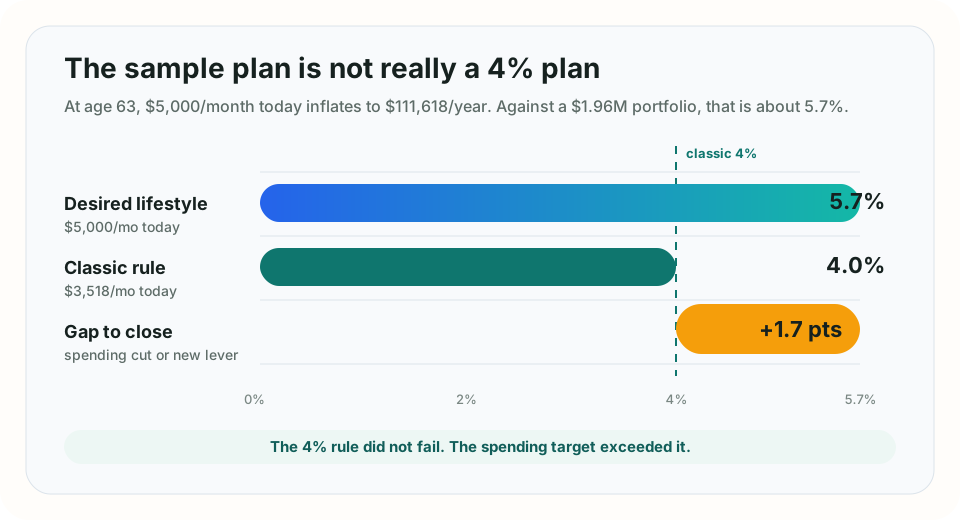
The household wanted to spend $5,000 per month in today's dollars after retiring at 63. By the first retirement year, inflation turned that into about $111,618 per year. Against a projected retirement portfolio near $1.96 million, the first-year withdrawal rate was roughly 5.7%.
That is not a 4% plan. It is a 5.7% plan wearing a 4% label.
The Short Answer
The 4% rule can still be useful if you treat it as a spending constraint, not a promise.
But in this stress test, "safe" is a strong word for either version of the plan. Under tax-aware assumptions the fixed-dollar 4% version simulated at about two in three (roughly 68% success), and the household's desired $5,000/month lifestyle at fewer than one in four (roughly 23%). The 4% version is clearly the stronger of the two — but a one-in-three chance of falling short is not what most people hear in the word "safe".
- Fixed-dollar 4% withdrawals test whether your planned lifestyle survives.
- Percent-of-portfolio withdrawals test a different strategy where spending flexes with markets.
- Long retirements, early retirement, high fixed costs, and bad first-decade returns make 4% weaker.
- Social Security, pensions, downsizing, flexible spending, or part-time work can make it stronger.
- Monte Carlo simulation is the better next step because it tests many possible market paths.
If you are still at the earlier "what age can I retire?" stage, use the Financial Independence Planner first. It asks for the retirement age and monthly spending in plain English before sending you deeper into withdrawal-rate nuance.
The Scenario
We ran a mid-career household through the retirement calculator:
- Current age: 42
- Retirement age: 63
- Plan-to age: 95
- Current retirement savings: $350,000
- Monthly contribution: $2,000, increasing 2% per year
- Desired retirement spending: $5,000/month in today's dollars
- Inflation: 3%
- Social Security: $2,200/month at full retirement age
- Life event: $30,000/year of college expenses from ages 48-52
- Monte Carlo simulation: 1,000 randomized market paths
Open the $5,000/month sample in the calculator to start with the assumptions above, then map the ages, savings, spending, and Social Security to your situation.
What Changed With a Fixed-Dollar 4% Start
When people cite the classic 4% rule, they usually mean this: withdraw 4% of the starting retirement portfolio in year one, then increase that dollar amount with inflation. That is different from withdrawing 4% of whatever the portfolio is worth every year.
At retirement, the calculator projected a portfolio near $1.96 million. Four percent of that is about $78,500 in the first retirement year. Converted back into today's spending power, that is about $3,518 per month.
The original $5,000/month lifestyle was funded only to about age 87, and under tax-aware assumptions its Monte Carlo success rate was under one in four (roughly 23%). The fixed-dollar 4% starting withdrawal was funded past age 95 and simulated at about two in three (roughly 68%). The 4% version is clearly the stronger of the two plans — yet a third of simulated markets still fall short of the horizon.
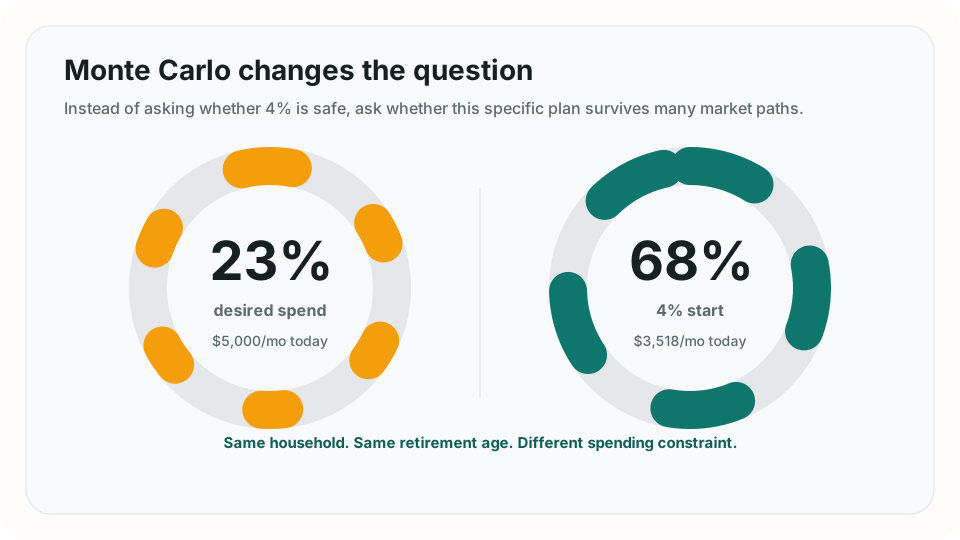
This is the part the rule is good at: it turns a vague question into a measurable gap. The plan does not need a slogan. It needs a lever.
Possible levers:
- Spend less in retirement.
- Retire later.
- Save more before age 63.
- Delay Social Security.
- Add part-time income.
- Downsize or remove a fixed expense.
- Use flexible withdrawals or guardrails.
If the plan depends on delaying Social Security after an early retirement date, model those years separately; our guide to retiring at 62 and delaying Social Security until 70 walks through that bridge-period stress test.
Funded Age Makes the Tradeoff Easier to See
Success probability is useful, but funded age is often easier to understand. This sample household plans to age 95. The original spending plan reaches about age 87. The fixed-dollar 4% starting withdrawal reaches the full planning horizon.
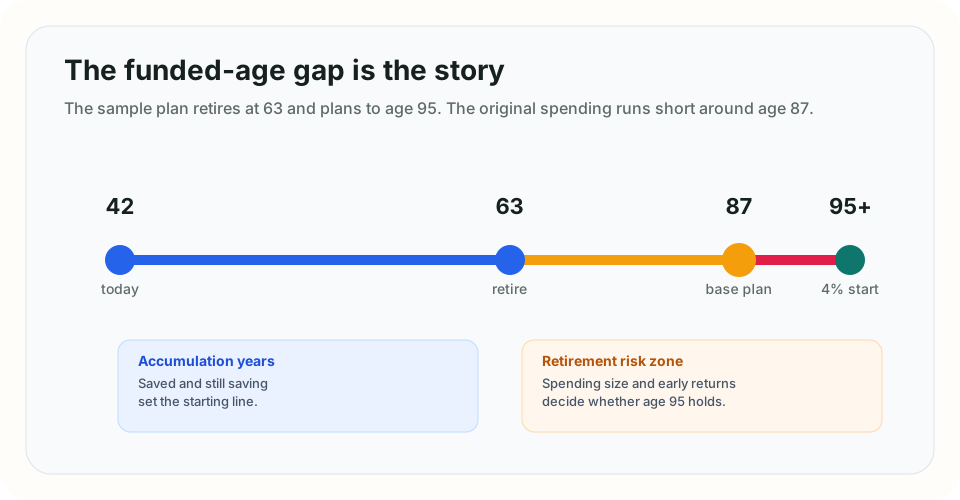
That eleven-year shortfall is the practical meaning of "4% might not be safe for you." It does not mean retirement fails on day one. It means the plan depends on favorable markets, spending cuts, or another income source later.
The Common Trap: Percent of Portfolio
There are two different strategies people call "4%":
- Withdraw 4% in year one, then adjust that dollar amount for inflation.
- Withdraw 4% of whatever the portfolio is worth each year.
Those are not the same rule.
The fixed-dollar version tests whether your planned lifestyle survives. The percent-of-portfolio version lets spending fall when the portfolio falls. That can protect the portfolio, but it may not protect your lifestyle.
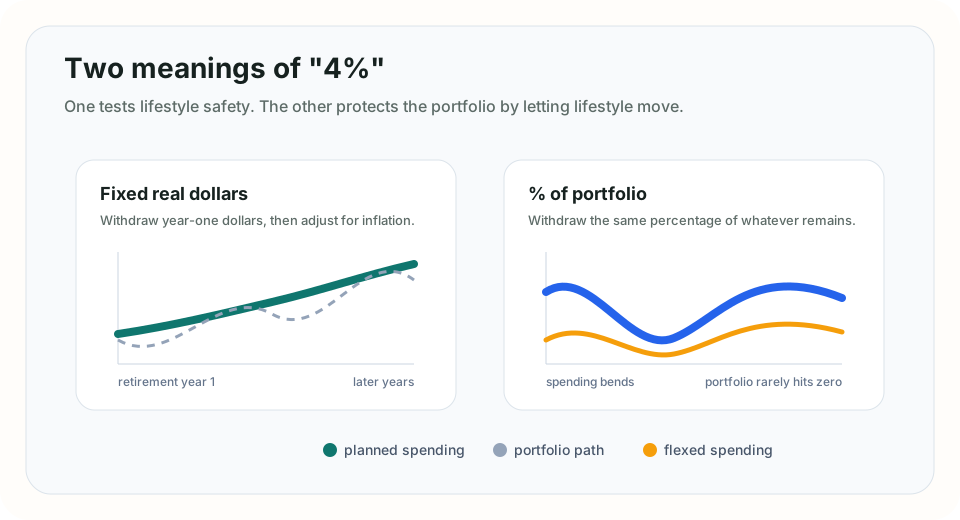
This is why a near-100% success rate in a percentage-of-portfolio strategy should not be compared directly with the success rate for fixed inflation-adjusted spending. One strategy is asking, "Can I keep this paycheck?" The other asks, "Can the account avoid depletion if my paycheck changes?"
A Better Way to Use the 4% Rule
Use the 4% rule in three passes:
- Translate your desired spending into a first-year retirement withdrawal rate.
- Stress-test that spending with Monte Carlo simulation.
- Decide whether any shortfall should be solved with lower spending, later retirement, higher savings, more income, or flexible withdrawals.
For the sample plan:
| Scenario | Spending | Result |
|---|---|---|
| Desired lifestyle | $5,000/month today | Funded to age 87 |
| Desired lifestyle with simulation | Same spending | roughly 23% success |
| Fixed-dollar 4% starting withdrawal | $3,518/month today | Funded past age 95 |
| Fixed-dollar 4% starting withdrawal with simulation | Same lower spending | roughly 68% success |
The 4% rule did not answer the retirement question by itself. It revealed which question to ask next.
Make the Example Your Own
Start from the article assumptions, then test three versions:
- Your desired spending in today's dollars.
- A fixed-dollar 4% starting withdrawal plan.
- A percentage-of-portfolio plan where spending flexes with the balance.
Compare funded age, probability of success, and what each version actually asks you to live on.
Related: What age can I retire? A financial independence reality check. For the current-year rate debate — Morningstar's 3.9%, Bengen's revised 4.7%, and the classic 4.0% — see which 4% withdrawal rate actually applies in 2026.
Sources
- Schwab: Beyond the 4% Rule
- Vanguard: FIRE and the 4% rule
- Morningstar: State of Retirement Income research
- Social Security Administration: Retirement benefit claiming age
Educational content only. This is not individualized financial, tax, legal, or investment advice.
More Retirement Calculator articles
Practical examples that connect the calculator to real planning decisions.
Can I Retire at 62 and Delay Social Security Until 70?
Retiring at 62 while delaying Social Security until 70 can work, but the eight bridge years decide the plan. See one calculator scenario and the key levers.
The 4% Rule in 2026: Morningstar Says 3.9%, Bengen Now Says 4.7% - Which One Applies to You?
Morningstar says 3.9%, Bengen says 4.7%, and the classic rule says 4.0%. See one retirement calculator scenario tested across all three rates.