Yes, it can work. But the hard part is not the Social Security claiming decision by itself. The hard part is the bridge.
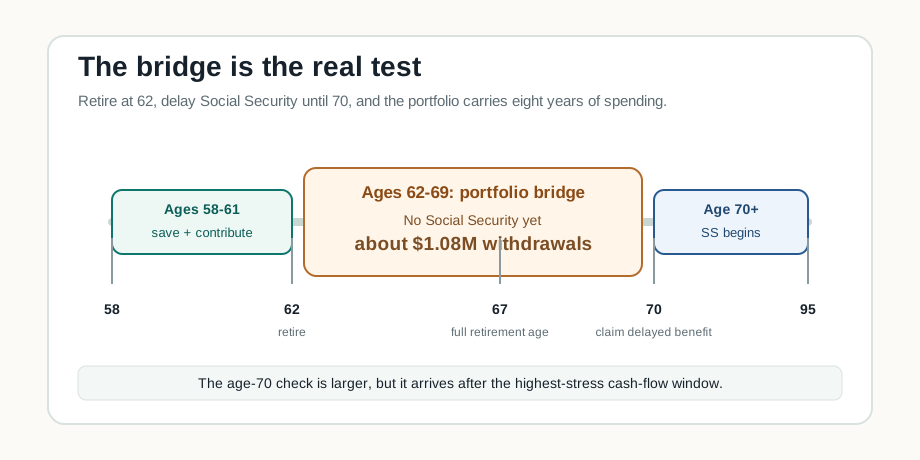
If you retire at 62 and delay Social Security until 70, your portfolio has to cover eight years of spending before the bigger Social Security check arrives. That can be a smart tradeoff for someone with enough savings, a spouse or pension income, part-time work, or flexible spending. It can also be the exact place an otherwise good-looking retirement plan breaks.
We ran one near-retirement household through the retirement calculator to make the tradeoff concrete.
The Short Answer
Retiring at 62 and claiming Social Security at 70 is usually a bridge-year question:
- The retirement age sets when paychecks and contributions stop.
- The claiming age sets when Social Security income starts.
- Waiting until 70 can raise the monthly benefit, but it also lengthens the portfolio-only period.
- The plan needs enough liquid, stable resources to survive ages 62 through 69 without forcing bad market-timing withdrawals.
For a worker born in 1960 or later, full retirement age is 67 under current Social Security rules. In this calculator scenario, the estimated full-retirement-age benefit is $3,200 per month in today's dollars. Claiming at 70 increases that benefit to about $3,968 per month, or 24% more than the age-67 amount.
That higher income helps later. It does not pay the bills from 62 to 69.
The Scenario We Tested
Here is the household:
| Input | Assumption |
|---|---|
| Current age | 58 |
| Retirement age | 62 |
| Plan-to age | 95 |
| Current retirement savings | $1,250,000 |
| Monthly contribution until retirement | $3,000 |
| Spending goal | $7,000 per month in today's dollars |
| Inflation and Social Security COLA | 3% |
| Full-retirement-age Social Security estimate | $3,200 per month at 67 |
| Delayed claiming scenario | $3,968 per month at 70 |
| Allocation | Default calculator glide path |
By age 62, the calculator projects the portfolio at roughly $1.74 million before the first retirement-year draw.
The age-62-to-70 bridge is the stress test. In this example, the portfolio needs to fund about $1.08 million of gross withdrawals from ages 62 through 69 before the delayed Social Security benefit starts. That number is nominal, not today's dollars, because inflation is applied each year.
Open the prefilled age-62 bridge scenario in the retirement calculator to start with the assumptions above, then map the ages, spending, savings, and claiming date to your situation.
What Claiming at 70 Changes
Delaying to 70 buys this household a bigger inflation-adjusting income floor — $3,968 a month instead of $3,200, for life, rising with inflation.
What it does to the portfolio is smaller than you might expect, in either direction. In the calculator's deterministic projection the money lasts to about age 88 whether this household claims at 67 or at 70 — the funded age is effectively a tie. The simulation separates them only modestly, and in the delayed plan's favor: about 25% of market paths survive the age-70 plan against about 21% for the age-67 version.
The bridge is why the gap stays small. Retiring at 62 and waiting until 70 means eight years funded entirely from the portfolio — about $1.08 million — against five years and about $644,000 if you claim at 67. The larger cheque then spends the rest of the plan working that extra drawdown back: by plan age the two roughly cancel in the deterministic projection, and the bigger inflation-adjusting benefit is what gives the age-70 plan its modest edge across simulated markets.
So the case for delaying is not a dramatically longer-lasting portfolio — for this household the deterministic funded age barely moves. It is insurance with a small tailwind: a permanently larger, inflation-protected floor for however long you live, which in this scenario also nudges the simulated survival odds slightly upward. What the delay costs is flexibility during the bridge years, when the portfolio is the only paycheck — and none of this is individual claiming advice; it is one household's numbers.
| Scenario | Portfolio-only bridge | Monthly Social Security in today's dollars | Deterministic funded age | Sample Monte Carlo result |
|---|---|---|---|---|
| Retire 62, claim 67 | Ages 62-66, about $644,000 | $3,200 | 88 | About 21% |
| Retire 62, claim 70 | Ages 62-69, about $1.08 million | $3,968 | 88 | About 25% |
| Retire 65, claim 70 | Ages 65-69, about $703,000 | $3,968 | Past 95 | About 52% |
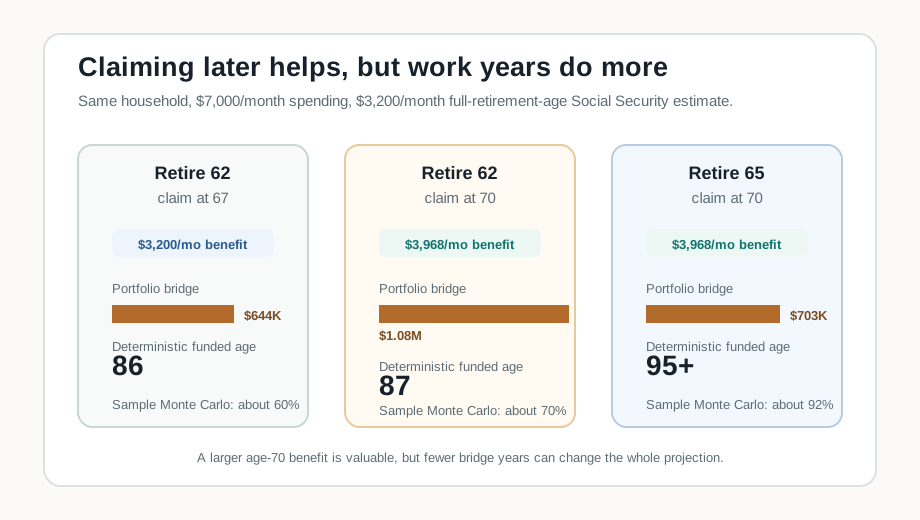
The lesson is not "always work to 65." It is that the retirement date is often more powerful than the claiming date. Three more working years can do three things at once:
- Add contributions.
- Reduce the number of portfolio-only bridge years.
- Shorten the total number of years the portfolio must support.
Why Waiting Until 70 Can Still Be Attractive
Waiting can still be the right move when the household has enough bridge funding. The benefit is not just a larger first check. It is a larger lifetime income floor that keeps adjusting with Social Security cost-of-living increases.
That matters most when:
- You expect one or both spouses to live into their late 80s or 90s.
- You want more guaranteed income later in life.
- Your portfolio is large enough to cover the bridge without panic selling.
- You have cash, bonds, taxable savings, a pension, or part-time income to soften the 62-to-70 period.
- Survivor benefit planning makes the larger benefit valuable for the longer-living spouse.
The claiming delay is a longevity hedge. The bridge is the price of buying it.
The Bridge-Year Checklist
Before treating age 62 plus Social Security at 70 as "done," pressure-test these items:
- Health insurance before Medicare. Medicare usually starts at 65, so ages 62 through 64 need their own health-insurance plan.
- Tax location. Pulling from a taxable account, traditional IRA, Roth IRA, or cash reserve can change the after-tax bridge cost.
- Market sequence risk. A bear market in the first few retirement years is much harder when the portfolio is your only paycheck.
- Cash buffer. A dedicated bridge reserve can prevent forced stock sales, but too much cash can drag down long-term growth.
- Spending flexibility. The plan looks different if travel, gifts, cars, or home projects can pause after a bad market year.
- Spouse and survivor rules. The highest benefit may matter more for the longer-living spouse than for the first retiree alone.
If any of those are fuzzy, do not treat the Social Security claiming age as a standalone optimization.
A Practical Way to Test Your Own Plan
Run the plan in this order:
- Model your desired retirement age with Social Security at full retirement age.
- Change only the claiming age to 70 and compare funded age, ending balance, and Monte Carlo range.
- Add a version where retirement moves later by one, two, or three years.
- Add a lower-spending version for ages 62 through 69.
- Add any real bridge income: pension, part-time work, rental income, or a planned downsizing event.
Then look for the first version that survives both the deterministic projection and a bad first-decade market sequence. If the plan only works with average returns, the bridge is too thin.
How This Relates to the 4% Rule
The 4% rule is a starting point, not a bridge plan. A household can have a reasonable starting withdrawal rate and still be fragile if the first eight retirement years are all portfolio-funded.
For a broader withdrawal-rate stress test, see Is the 4% Rule Still Safe in 2026?. For a comparison of expert withdrawal-rate headlines, see The 4% Rule in 2026.
If you are earlier in the process and mostly want to answer "what age can I retire with this monthly spending?", start with the Financial Independence Planner. Then come back to this bridge-year test when Social Security timing becomes the deciding variable.
Make the Example Your Own
Start from the article assumptions, then test these three cases:
| Case | Retirement age | Social Security claiming age | What to watch |
|---|---|---|---|
| Baseline | 62 | 67 | Does the plan survive with the shorter bridge? |
| Delay | 62 | 70 | Does the larger benefit compensate for the longer bridge? |
| Work longer | 65 | 70 | How much do fewer bridge years change the plan? |
The right answer is not always the highest Social Security check. The right answer is the claim age that fits the whole retirement cash-flow plan.
Sources
- Social Security Administration: retirement age and full retirement age
- Social Security Administration: delayed retirement credits
- Social Security Administration: early retirement reductions
- Consumer Financial Protection Bureau: planning your Social Security claiming age
Educational content only. This is not individualized financial, tax, legal, Social Security, or investment advice.
More Retirement Calculator articles
Practical examples that connect the calculator to real planning decisions.
The 4% Rule in 2026: Morningstar Says 3.9%, Bengen Now Says 4.7% - Which One Applies to You?
Morningstar says 3.9%, Bengen says 4.7%, and the classic rule says 4.0%. See one retirement calculator scenario tested across all three rates.
Is the 4% Rule Still Safe in 2026? A Visual Stress Test
Use charts to see how the 4% rule works as a starting withdrawal test, why flexible spending changes the result, and when Monte Carlo stress testing matters.