If you've read anything about retirement in the last 18 months, you've probably noticed something strange: nobody seems to agree on the 4% rule anymore.
- Morningstar's 2025 update puts its base-case starting rate at 3.9% — up from the 3.7% its 2024 report made famous. That figure has a narrow definition: a 90% success rate over 30 years, with fixed, inflation-adjusted spending and no Social Security or other income from outside the portfolio.
- Bill Bengen — the guy who invented the 4% rule in 1994 — now says 4.7% is fine.
- A pile of advisors still default to a flat 4.0%.
So which is right? The honest answer: all three, and none of them. The "right" rate depends on your portfolio, your timeline, and how you actually plan to spend.
To make that concrete, we ran one household through the retirement calculator at all three withdrawal rates. Here's what changed — and what didn't.
If your first question is less about the withdrawal-rate debate and more about "what age can I retire with this monthly spending?", start with the Financial Independence Planner. It keeps the same retirement cash-flow foundation but frames the result around age, spending, and whether the plan lasts.
The household we tested
To keep this an apples-to-apples comparison, we used the calculator's built-in "Filled-out example" household:
| Current age | 50 |
| Retirement age | 63 |
| Plan-to age | 92 (30-year retirement) |
| Total saved today | $755,000 across 401(k), Roth IRA, taxable brokerage, and HSA |
| Monthly contribution | $4,641 + $463/mo employer match |
| Pre-retirement allocation | 70% stocks / 25% bonds / 5% cash |
| Post-retirement allocation | 45% stocks / 45% bonds / 10% cash (standard glide-down) |
| Social Security | $3,200/mo at FRA 67, 2.5% COLA |
| Inflation assumption | 3% |
| Projected portfolio at retirement | $2,887,323 (or $1,966,127 in today's dollars) |
This household is realistic for the "DIY mass-affluent" segment — meaningful savings, a real glide path, Social Security in the mix, multiple account types with different tax treatments.
Open the prefilled 4% rule comparison to start with this household's assumptions, then map the ages, account balances, contribution schedule, Social Security, allocation, and spending mode to your situation.
Then we varied one thing only: the Year-1 withdrawal rate.
Three withdrawal rates, three different retirements
3.9% — Plan in 30's replay at Morningstar's starting rate
First, the boundary. Morningstar's 3.9% is the starting withdrawal rate that succeeded in 90% of its simulations over a 30-year horizon, with fixed, inflation-adjusted spending and no non-portfolio income. Our household keeps its $3,200/mo Social Security, runs to plan age 92, and uses our own return and volatility assumptions. So everything in this section is Plan in 30's replay at a 3.9% starting-spend target — not Morningstar's result. The success rate below is our number for our experiment; it does not say Morningstar's benchmark is 69% safe, and Morningstar has not validated this household's plan.
Year 1 spending: $6,410/mo in today's dollars ($112,960/yr inflation-adjusted in Year 1 of retirement).
Monte Carlo: 69% probability of success.
Funded past plan age 92, ending balance ~$2.9M.
This is the leave-room-for-a-bad-sequence version of this household's plan. On the average-return path it finishes with seven figures for legacy or unexpected expenses, and roughly seven in ten simulated markets reach plan age. The lower starting spend is buying that cushion — a different claim from the 90% safety Morningstar's own contract describes.
Worth noting: Morningstar's own number moved up. Their 2024 report said 3.7% (replayed for this household the same way: $6,081/mo, 76% success, ~$3.6M ending). The 2025 edition raised the base case to 3.9% on higher expected fixed-income returns — which means the lower benchmark rate and the classic 4% are now separated by less than $170 a month for this household.
The classic 4.0% — Bengen's original 1994 paper
Year 1 spending: $6,574/mo in today's dollars ($115,850/yr in Year 1).
Monte Carlo: 66% probability of success.
Funded to Age 92+, ending balance ~$2.5M.
Still comfortably funded on the average-return path. And here's what the 2025 revision changed: against Morningstar's current 3.9%, the classic 4.0% costs this household only $164/mo more spending for about $0.4M less legacy (against the old 3.7% base it was $493/mo and a full $1M). The 3.9% replay and the textbook rule have nearly converged — the real divide in 2026 is with Bengen's 4.7%.
Bengen-updated 4.7% — "the new gold standard"
Year 1 spending: $7,724/mo in today's dollars ($136,115/yr in Year 1).
Monte Carlo: 41% probability of success.
Reaches plan age 92 with about $0.2M left — but on barely more than a third of simulated markets.
Wait. Bengen himself revised his own number UP — and the calculator is telling us this household's plan is more likely to fail than succeed at his updated rate? On average returns the plan limps into plan age 92 with about $0.2M left of what began as a $2.9M portfolio — and fewer than half of simulated markets get even that far.
Yes. And this is where the headlines get dangerous.
Why Bengen says 4.7% — and why it doesn't apply to most people
Bengen's 2024 update isn't wrong. He revised the rate upward because his historical research now includes:
- Small-cap value tilts (which have outperformed historically)
- A higher equity allocation maintained through retirement (not the standard glide-down)
- A more diversified asset mix including international and real estate
Most households — including ours — don't do that. The default post-retirement allocation in our example glides from 70/25/5 down to 45/45/10 by retirement. That's a sensible "don't blow up at 80" choice, but it's not the portfolio Bengen modeled.
So we ran a fourth scenario: same 4.7% withdrawal rate, but hold the 70/25/5 allocation through retirement instead of gliding down.
4.7% withdrawal + aggressive 70/25/5 in retirement
Monte Carlo: 48% probability of success (up from 41%).
Funded to Age 92+, ending balance ~$1.8M (up from about $0.2M).
The plan went from scraping into plan age with about $0.2M to reaching it with roughly $1.8M still invested — just by holding more stocks in retirement. The blended post-retirement return rose from 4.88% to 5.85%.
That's a real improvement. It's also a real risk: at 70/25/5, a 2008-style crash 3 years into retirement can vaporize a decade of safety. You can't get Bengen's 4.7% without taking Bengen's allocation.
The trap: "% of portfolio" mode never fails
While running these scenarios, we found something worth flagging.
Our calculator (like most) lets you express spending two ways:
- $ Amount: a fixed real-dollar paycheck (inflation-adjusted), which is what Bengen actually means.
- % Balance: 4% of current balance, recomputed each year.
Set % Balance to 4%, and the calculator returns a 100% probability of success — automatically.
That's not because 4% is magically safe. It's because if your spending shrinks with your portfolio, the portfolio mathematically cannot deplete. You'd just be eating cat food in your 80s.
The calculator literally calls this out:
"100% is expected in % Balance mode because spending scales with the balance. Switch to $ Amount to test a fixed lifestyle."
When experts quote "safe withdrawal rate," they mean the fixed-real-dollar version. The constant-percentage version is a different (and inferior, for most people) strategy. Don't confuse the two.
The actual takeaway
The 4% rule isn't dead. It also isn't 3.9% or 4.7%. It's a starting point that you have to adjust for your plan. For the evergreen version of the same question, see our guide to whether the 4% rule is still safe in 2026. If your retirement date comes before Social Security starts, also test the bridge years with retiring at 62 and delaying Social Security until 70.
For our test household with a standard glide-down portfolio, here's the honest summary:
| Rule | Yr 1 spend | Success | Ending balance |
|---|---|---|---|
| 3.9% (Plan in 30 replay at Morningstar's rate) | $6,410/mo | 69% | $2.9M |
| Classic 4.0% | $6,574/mo | 66% | $2.5M |
| Bengen-updated 4.7% (glide-down) | $7,724/mo | 41% | $0.2M |
| Bengen-updated 4.7% (stay 70/25/5) | $7,724/mo | 48% | $1.8M |
The 3.9% row is Plan in 30's replay at Morningstar's starting rate with this household's Social Security included. Morningstar's published 3.9% is a 90%-success, 30-year, no-Social-Security result and is not reproduced here.
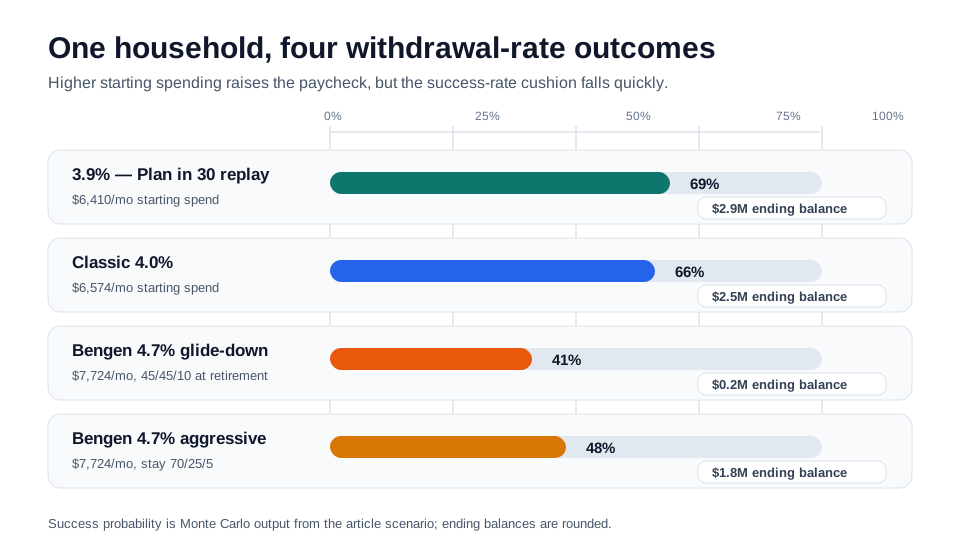
The visual makes the tradeoff clearer than the table alone: the extra spending from 4.0% to 4.7% is visible immediately, but the success-rate bar drops faster than the paycheck rises. The aggressive-allocation version rebuilds the ending-balance cushion, yet it still leaves the plan with a lower success rate and less legacy cushion than the lower-rate cases.
A few things that pop out of the math:
- The gap between 3.9% and 4.0% is now small — and that's the story. Morningstar's 2025 revision closed most of the distance to the classic rule: $164/mo of spending and about $0.4M of legacy separate them for this household. A year ago (at 3.7%) that gap was $493/mo and a full $1M. If "leave money for the kids" matters, the lower rate is still paying for it — just less dramatically.
- The gap between 4.0% and 4.7% is huge. A $1,150/mo bump cuts your success rate from 66% to 41%, and the ending balance from about $2.5M to about $0.2M. On average returns it still reaches plan age — but it does so on fumes, and fewer than half of simulated markets get there at all.
- Allocation matters more than the rate. Holding 70/25/5 vs gliding to 45/45/10 added 6 points of success at the same spending. The rate is downstream of the portfolio.
- Social Security is the floor. Even in the 41%-success scenario, this household keeps $4,869/mo (in future dollars at claiming) coming in from SS. Running out doesn't mean zero income — it means a forced lifestyle cut.
Make the Example Your Own
The point of running the same household through three rates wasn't to crown a winner. It was to show that the "safe withdrawal rate" debate is downstream of your portfolio, your timeline, and your tolerance for variability.
Start from the article assumptions, then test these versions:
- Your actual account balances and monthly contributions.
- A 3.9%, 4.0%, and 4.7% first-year withdrawal target.
- Your current allocation versus the retirement allocation you could actually hold through a downturn.
- A version where spending flexes with the portfolio instead of staying fixed in real dollars.
The honest version of "what's my safe rate?" is whichever rate gives you the Monte Carlo success probability you can actually sleep with. For most people we've seen, that answer lands closer to 3.9-4.0% than to 4.7%. But yours might be different, and that's exactly the point.
For the simpler early-retirement version of the question, use the Financial Independence Planner to test the two levers most readers ask about first: "what age can I retire?" and "what can I spend if I retire at this age?"
Sources
- Morningstar, "The State of Retirement Income: 2025" research
- Bill Bengen, A Richer Retirement (2024) — the updated 4.7% defense
- Bengen's original 1994 paper: "Determining Withdrawal Rates Using Historical Data"
- IndexBox 2026 commentary: Retirement Savings Challenges and 4% Rule Criticism in 2026
Scenario Recipe
All four runs above use the same household assumptions. The exact recipe:
- Start from the prefilled household assumptions above.
- Scroll to the Retirement Spending panel and confirm the toggle is set to "$ Amount" (not "% Balance" — that mode auto-returns 100%).
- Scroll to Post-Retirement Allocation and confirm it's set to 45 / 45 / 10 (Stocks / Bonds / Cash). If it's set to 70/25/5, change it back — this is the standard glide-down.
- Change Monthly Spending in Today's $ to each of the four values below and compare the headline + Monte Carlo donut:
| Scenario | Spending | Allocation | Expected headline |
|---|---|---|---|
| 3.9% (Plan in 30 replay at Morningstar's rate) | $6,410/mo | 45/45/10 | Funded 92+, 69% success, $2.9M end |
| Classic 4.0% | $6,574/mo | 45/45/10 | Funded 92+, 66% success, $2.5M end |
| Bengen 4.7% (glide-down) | $7,724/mo | 45/45/10 | Funded 92+ with ~$0.2M, 41% success |
| Bengen 4.7% (aggressive) | $7,724/mo | 70/25/5 | Funded 92+, 48% success, $1.8M end |
Both numbers are reproducible: the simulation is seeded, so re-running the same scenario gives the same success rate rather than one that wobbles by a point or two.
Educational content only. This is not individualized financial, tax, legal, Social Security, or investment advice.
More Retirement Calculator articles
Practical examples that connect the calculator to real planning decisions.
Can I Retire at 62 and Delay Social Security Until 70?
Retiring at 62 while delaying Social Security until 70 can work, but the eight bridge years decide the plan. See one calculator scenario and the key levers.
Is the 4% Rule Still Safe in 2026? A Visual Stress Test
Use charts to see how the 4% rule works as a starting withdrawal test, why flexible spending changes the result, and when Monte Carlo stress testing matters.