The most useful financial independence question is usually not "What is my FIRE number?" It is simpler:
If I stopped working at this age and kept this monthly spending, would the money last?
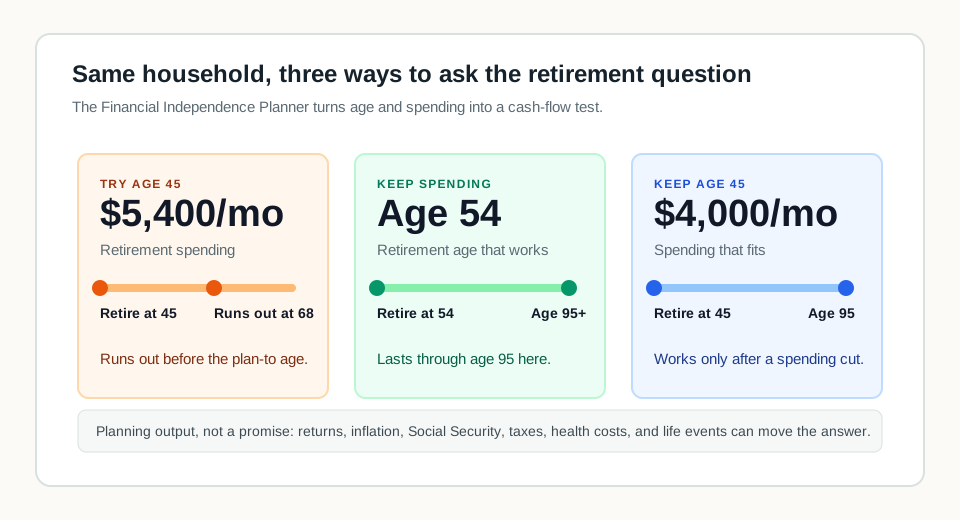
In one sample plan, the answer was uncomfortable. A 32-year-old with $200,000 invested, saving $4,000 per month, and planning to spend $5,400 per month in retirement could not retire at 45 under the starting assumptions. The money lasted to about age 68, not the age-95 planning horizon.
The same household had two cleaner options:
- Keep the $5,400/month spending goal and move retirement to about age 54.
- Keep age 45 and lower retirement spending to about $4,000/month.
That is the point of a financial independence calculator. It should turn a dream date into a testable tradeoff.
Short Answer
Financial independence means your investments and planned income can support your spending without a paycheck. For an early retirement plan, the two questions most people need first are:
- What age can I retire with this monthly spending?
- What monthly spending works if I retire at this age?
The Financial Independence Planner is designed for those two questions. It uses the same mature cash-flow engine as the Retirement Calculator, but labels the workflow around early retirement and plain-English "retire at" choices.
The Scenario We Tested
Here is the sample household:
| Input | Assumption |
|---|---|
| Current age | 32 |
| Target retirement age | 45 |
| Plan-to age | 95 |
| Current invested savings | $200,000 |
| Monthly contribution before retirement | $4,000 |
| Contribution increase | 2% per year |
| Retirement spending | $5,400/month in today's dollars |
| Inflation | 3% |
| Social Security estimate | $1,500/month at age 67 |
| Other income | $1,500/month rental income from age 35 to 90 |
| Return assumptions | 75/20/5 before retirement, 40/50/10 after retirement |
Open the prefilled age-45 scenario in the planner to start with the assumptions above, then map the age, savings, spending, Social Security, and rental income to your situation.
What the Planner Says
At age 45, the portfolio is projected to be about $1.76 million before withdrawals begin. That sounds large. But the retirement is also long: 50 years from age 45 to age 95.
With $5,400/month spending in today's dollars, increasing with inflation, the plan runs out around age 68.
That does not mean age 45 is impossible for everyone. It means this age-45 version needs a lever:
| Version | Result |
|---|---|
| Retire at 45, spend $5,400/month | Runs out around age 68 |
| Retire at 50, spend $5,400/month | Runs out around age 85 |
| Retire at 54, spend $5,400/month | Lasts through age 95, with about $1.36 million projected at the end |
| Retire at 45, lower spending | About $4,000/month lasts to age 95 in this scenario |
The key is that the calculator is answering the question you actually highlighted. If the left side says "Retire at 45," the headline should judge the age-45 plan first, then show the age or spending that would make the plan work.
Why the 4% Rule Is Helpful but Not Enough
The 4% rule is a starting point: withdraw 4% of the portfolio in the first retirement year, then adjust that dollar amount for inflation. Schwab describes it as a rule of thumb for a 30-year retirement, not a personalized spending plan.
Early retirement stretches the timeline. Vanguard notes that people pursuing financial independence may need a much longer horizon than a traditional 30-year retirement, plus attention to costs, diversification, and flexible spending.
That is why the planner should not stop at "annual spending times 25." It should show the cash flow:
- How much is invested when work stops?
- How many years must the portfolio support?
- Which income starts later, such as Social Security or rental income?
- What happens when inflation raises the dollar amount of spending?
- Does the plan survive the full planning horizon?
The Two Calculator Buttons That Matter Most
A financial independence planner should answer the user's next question directly:
| User question | Calculator should solve |
|---|---|
| "What age can I retire with this spending?" | Retire age |
| "What can I spend if I retire at 45?" | Monthly spending |
| "What happens if I plan to age 95 instead of 90?" | Funding horizon |
The other financial independence terms, such as lean, coast, or fat financial independence, can be useful later. They should be opt-in learning paths, not the first screen's main result. Most people want the plain-English answer first.
What Changes the Answer
The retirement age can move a lot when any one assumption changes.
- Monthly spending: This is usually the biggest lever. In the sample plan, lowering spending from $5,400 to about $4,000 makes age 45 work.
- Savings rate: More monthly investing before retirement gives the portfolio more fuel.
- Return assumption: A higher return can make the answer look earlier, but it also adds risk if the return is too optimistic.
- Inflation: Higher inflation makes a fixed lifestyle more expensive each year.
- Income after work stops: Social Security, pension income, rental income, or part-time work can reduce portfolio withdrawals.
- Plan-to age: Planning to 95 is more conservative than planning to 85, especially for a retirement that starts in your 40s.
- Big events: Home purchases, college costs, medical costs, family help, or long-term care can change the path.
When to Use This Planner vs. the Retirement Calculator
Use the Financial Independence Planner when your main question is:
- What age can I retire?
- What monthly spending works if I retire at this age?
- How does changing age, spending, savings, or return assumptions move the answer?
Use the Retirement Calculator when your main question is broader retirement income strategy, such as Social Security timing, a traditional retirement date, detailed cash-flow planning, or a deeper scenario simulation. The two tools intentionally share the same planning foundation so improvements to one can help the other.
For withdrawal-rate background, read Is the 4% Rule Still Safe in 2026?. If your retirement date comes before Social Security starts, read Can I Retire at 62 and Delay Social Security Until 70? for a bridge-year example.
Make the Example Your Own
Start from the article assumptions, then test a few versions against your situation:
- Change Retire at from 45 to 50, 52, 54, and 55.
- Put Retire at back to 45 and lower monthly spending until the plan lasts to 95.
- Turn on simulation if you want to see how bad market timing could change the answer.
- Save the version that feels realistic, not just the version that looks best.
Sources
- Vanguard: Early retirement and the 4% rule
- Schwab: The 4% Rule: How Much Can You Spend in Retirement?
- Social Security Administration: retirement age and benefit reduction
- Investor.gov: compound interest calculator
Educational content only. This is not individualized financial, tax, legal, Social Security, or investment advice.