Short Answer
To find your monthly savings number, take the amount you still need and divide it by the number of months you have:
Monthly amount = (Goal − What you've already saved) ÷ Months until the deadline
If you want $24,000, you already have $6,000 set aside, and your deadline is 18 months away, you need to save $1,000 a month:
($24,000 − $6,000) ÷ 18 months = $1,000 / month
That's the whole idea. Everything else in this article is about making the number realistic: picking a deadline you can sustain, using a head start wisely, and getting back on track when a month goes sideways.
What "Save Each Month" Really Means
A savings goal has three moving parts:
- The target — the dollar amount you're trying to reach.
- The head start — what you've already saved toward it.
- The deadline — when you need the money.
The monthly amount is just what's left to save, spread evenly across the months you have. The reason the formula subtracts your head start before dividing is important: every dollar you've already saved removes a dollar from the total you have to divide up, so a head start does more than it looks like it should (more on that below).
One deliberate choice in the Savings Plan: it does not assume investment growth. The plan is built from contributions alone. If your money also earns interest in a savings account, that's a bonus that gets you there a little early or leaves you with a small cushion — but it's never counted on to hit the goal. For short-term goals, that's the safe way to plan, because you don't want to depend on a return that may not show up on schedule.
Why It Matters
A goal without a monthly number is just a wish. "I want to save $24,000" feels overwhelming. "I save $1,000 on the first of every month" is a habit you can actually run.
The monthly number also tells you, immediately, whether the plan is realistic. If the math says you need $2,000 a month and you have $600 of room in your budget, you've learned something useful before you've wasted a single month: the deadline needs to move, the goal needs to shrink, or you need to find more room. Better to know now than 14 months in.
Example Scenario: Maya's $24,000 Goal
Let's make it concrete. Maya is saving for a starter-home down payment, but the method is the same for any goal — a wedding, a car, a big trip, or a fully funded emergency fund.
- Goal: $24,000
- Already saved: $6,000
- Deadline: 18 months from now (around November 2027)
- Plan style: steady monthly saving, no high-interest debt
Her remaining amount is $24,000 − $6,000 = $18,000. Spread across 18 months, that's $1,000 per month. Here is how her balance climbs if she hits that number every month:
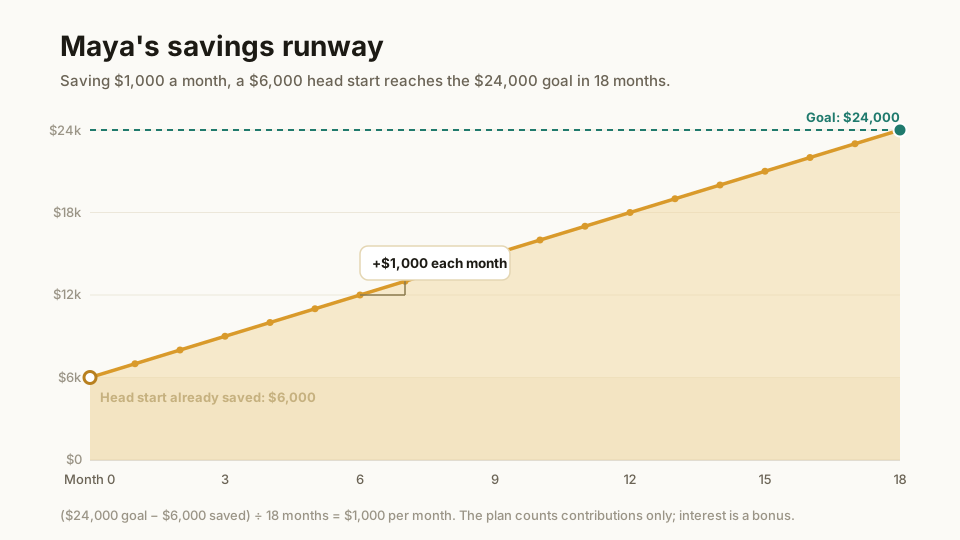
Each step is one month of saving $1,000. The head start of $6,000 means the line begins partway up, not at zero.
What the Calculator Shows
Maya's three numbers return the same $1,000 per month, then keep a running tracker:
| Field | Value |
|---|---|
| Target amount | $24,000 |
| Starting balance | $6,000 |
| Months until deadline | 18 |
| Amount still to save | $18,000 |
| Required monthly savings | $1,000 |
Open the prefilled Maya monthly savings scenario to start with the $24,000 target, $6,000 head start, and November 2027 deadline, then map the balance, date, and monthly habit to your situation.
As real months pass, Maya updates her actual balance and the planner shows whether she's ahead or behind — and quietly recalculates the monthly number if she drifts. That recalculation is the feature most savings articles skip, and it's covered below.
What Changes the Answer
Three levers move the monthly number. Knowing which one to pull is most of the skill.
1. The Deadline
Time is the most powerful lever. The same $18,000 remaining looks very different depending on how long you give yourself:
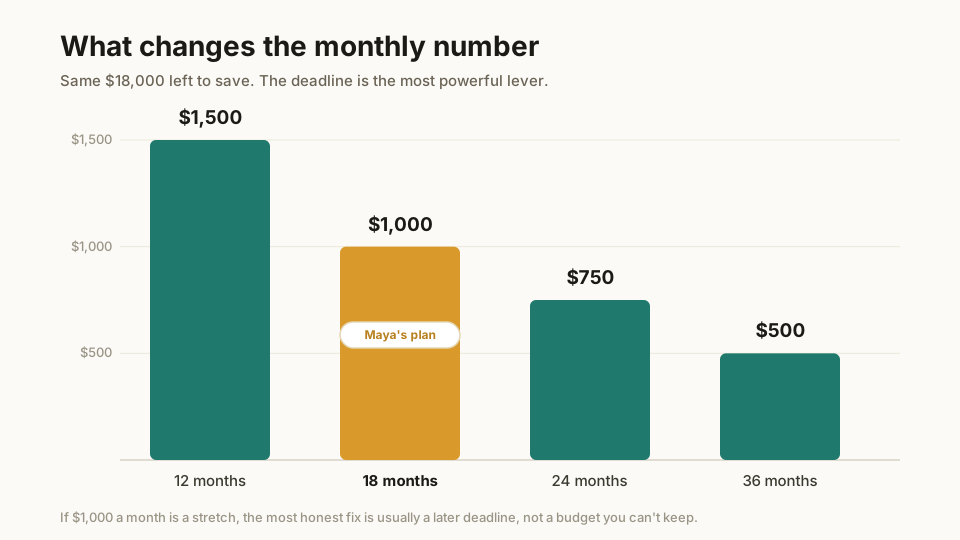
| Deadline | Monthly amount (for $18,000) |
|---|---|
| 12 months | $1,500 |
| 18 months | $1,000 |
| 24 months | $750 |
| 36 months | $500 |
Giving yourself an extra year here cuts the monthly amount by a third. If $1,000 a month is a stretch, the most honest fix is often a later deadline — not a tighter budget you can't keep.
2. The Head Start
Because your starting balance is subtracted before the division, a lump sum has outsized impact on the monthly figure for short goals. Holding the deadline at 18 months and the target at $24,000:
| Already saved | Monthly amount needed |
|---|---|
| $0 | ~$1,333 |
| $6,000 | $1,000 |
| $12,000 | ~$667 |
This is why throwing a tax refund, bonus, or windfall at a goal up front can be worth more than it feels like in the moment: $6,000 deposited today removes about $333 from every one of the next 18 monthly payments.
3. The Target Itself
The least flexible lever, but still a lever. A 6-month emergency fund built on $3,000 of monthly expenses is $18,000; trimming the underlying expenses, or deciding 4 months is enough to start, lowers the target directly. Right-size the goal to the real need before you stretch the budget to fund an inflated one.
When You Fall Behind
Most savings plans don't fail because the math was wrong. They fail because one bad month convinces the saver the whole plan is broken, so they quit.
It isn't broken. A missed month just means the remaining amount gets spread over fewer months, so the monthly number ticks up a little. Suppose Maya saves nothing for two months and is still sitting at $6,000. She now has 16 months left and still needs $18,000, so:
$18,000 ÷ 16 months = $1,125 / month
That's a $125 increase, not a catastrophe. The Savings Plan does this redistribution for you automatically: update your real balance, and it recalculates the monthly amount across the months you have left. The goal survives the bad month — you just adjust and keep going.
Common Mistakes
- Picking a deadline before checking the monthly number. Set the date, see the monthly amount, and adjust the date until the number is one you can actually sustain.
- Counting on investment returns for a short-term goal. Over 12–24 months, contributions do almost all the work; a market dip at the wrong moment can leave you short. Plan on the contributions and treat any interest as a buffer.
- Ignoring your head start. Money already saved should be entered as the starting balance — otherwise the monthly number is higher than it needs to be.
- Treating one missed month as failure. Recalculate and continue; a small bump beats abandoning the goal.
- Saving "what's left over." There usually isn't any. Move the monthly amount on payday, before you spend.
Make the Example Your Own
Start from Maya's $24,000 goal, then test three versions:
- Change the current balance so the monthly amount reflects your real head start.
- Move the deadline until the monthly number is one you can actually keep.
- Add a one-time deposit to see how much it lowers each remaining month.
Compare the required monthly savings, the remaining amount, and whether the plan still works after one missed month.
Related: How Long Will It Take to Reach My Savings Goal?
Related Reading
- How Long to Reach a Savings Goal? — start with the monthly amount you can afford and see which deadline it supports.
- How Much Should You Budget for a Wedding in 2026? — turn a total budget into a fundable plan, then hand it to the Savings Plan.
- Home Buyer and Rent vs. Buy — once the down payment is saved, check whether buying makes sense this year.
Sources and Notes
- NerdWallet — Savings goal calculator: how much to save per month
- Bankrate — Savings goal calculator
- Bankrate — 2026 Emergency Savings Report
- Consumer Financial Protection Bureau — An essential guide to building an emergency fund
- Wells Fargo — Pay yourself first
- Experian — Sinking fund vs. emergency fund
This article is educational planning content, not personalized financial advice. The Savings Plan calculates contributions only and does not assume investment growth; your own results will depend on your budget, your account's interest rate, and how consistently you save.
More Savings Goal Planner articles
Practical examples that connect the calculator to real planning decisions.
How Long Will It Take to Reach My Savings Goal?
Work backward from the monthly amount you can afford to see when your savings goal becomes realistic.
Baby's First-Year Budget: What Costs Hit Before Birth vs After Birth?
Separate first-year baby costs into what you need before birth, what hits during leave, and what becomes a monthly budget after childcare starts.
How Much Should You Save Before Your Baby Is Born?
Plan the cash you should have ready before the due date, including gear, medical buffers, feeding and diaper supplies, and the first childcare deposit.