The honest answer to "should I rent or buy?" is not a yes or a no. It's a number of years.
Buying a home costs a lot to get into (down payment, closing costs) and a lot to get out of (agent commissions, transfer taxes). Those one-time costs are the reason buying needs time to pay off. Your break-even point is the year at which owning finally pulls ahead of renting and investing the difference. Stay past it and buying wins. Sell before it and renting would have left you richer.
The short version:
- There is no universal "5-year rule." At today's mortgage rates (around 6.5% in mid-2026), the break-even year can land anywhere from under 3 years to never, depending mostly on how your rent compares to the home price.
- The biggest lever is the price-to-rent ratio — the home price divided by a year of rent. Low ratio (expensive rent, cheaper homes) means buying pays off fast. High ratio means renting can win for decades.
- Renting only wins if you actually invest the savings. The whole comparison assumes the renter puts the down payment and the monthly difference to work.
- A break-even year is a starting point, not a guarantee. It moves with rates, rent, returns, and how long you really stay.
What "Break-Even" Actually Means
Imagine two versions of you. One buys a house. The other rents the same house and invests every dollar the buyer tied up — the down payment, the closing costs, and any month where owning costs more than renting.
Each year we ask a simple question: if you sold the house today, who would have more money? Early on, the buyer is behind. They spent tens of thousands on the down payment and closing, and selling would cost another 6% or so in commissions and fees. The renter, meanwhile, has that same money compounding in the market.
Over time the buyer catches up. The mortgage balance shrinks, the home (usually) appreciates, and rent keeps rising while a fixed mortgage payment doesn't. The break-even year is the moment the buyer's net worth crosses above the renter's.
Break-even isn't about when your monthly payment beats rent. It's about total net worth — equity plus investments — after the costs of buying and selling.
Why It Matters
Most rent-vs-buy advice stops at "buy if you'll stay 5+ years." That rule comes from a real idea — transaction costs need years to amortize — but it was coined in a era of cheaper mortgages. At a 6.5% rate, the 5-year rule is often too optimistic. Knowing your actual break-even year tells you three useful things:
- Whether buying makes sense given how long you realistically expect to stay.
- How much margin for error you have if you move sooner than planned.
- Which lever (rent, rate, or returns) you'd need to change to flip the answer.
A Real 2026 Scenario
Let's use concrete numbers you can drop straight into the calculator. This is a typical "should we stop renting?" decision in a mid-priced market.
| Input | Value |
|---|---|
| Home price | $500,000 |
| Down payment | 20% ($100,000) |
| Mortgage | 30-year fixed at 6.5% |
| Monthly rent (same home) | $3,200 |
| Home appreciation | 3% / year |
| Investment return (renter) | 7% / year |
| Rent growth | 3% / year |
| Closing costs / selling costs | 3% / 6% |
Open the prefilled rent-vs-buy break-even scenario to start with the assumptions above, then map the rent, home price, mortgage rate, investment return, and time horizon to your situation.
A few things fall out of these inputs immediately:
- The renter starts with $115,000 to invest — the $100,000 down payment plus $15,000 in closing costs the buyer spends but the renter doesn't.
- The buyer's all-in monthly cost is about $3,645 in year one: roughly $2,528 in mortgage principal and interest, plus property tax (~$458), insurance (~$167), and maintenance and upkeep (~$492). That's about $445 more per month than the $3,200 rent — money the renter also invests.
- Rent rises 3% a year, so by year seven the renter is paying close to $3,900 while the buyer's mortgage payment hasn't moved.
Run the full month-by-month simulation and the two net-worth paths cross at about 6.7 years.
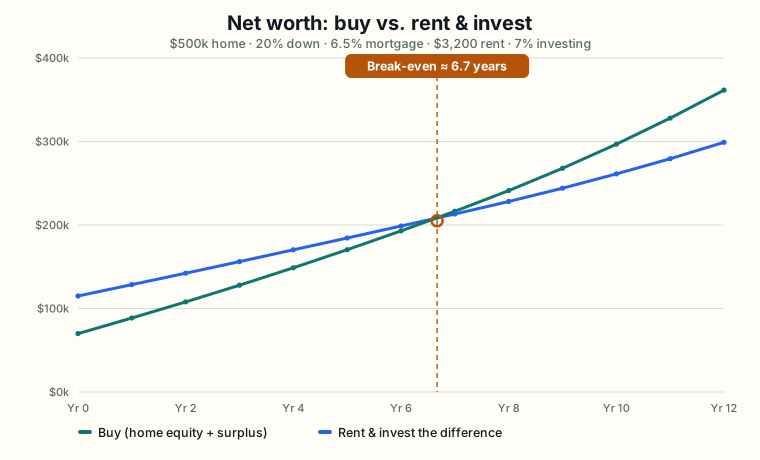
Both lines climb, but they climb differently. The renter starts ahead because their $115,000 is liquid and invested from day one. The buyer's wealth is mostly home equity, which grows as the loan is paid down and the home appreciates — and accelerates once rent inflation pushes renting above owning. They cross near year seven.
What the calculator shows at year 7
| Buy | Rent & invest | |
|---|---|---|
| Net worth at year 7 | ~$216,000 | ~$213,000 |
| Net worth at year 10 | ~$297,000 | ~$261,000 |
| Net worth at year 3 (if you moved early) | ~$128,000 | ~$156,000 |
At three years, renting is ahead by nearly $30,000 — selling that early means eating the buy-and-sell costs before equity had a chance to build. By year ten, buying leads by about $36,000 and the gap widens every year after.
What Changes the Answer
The break-even year is not fixed. Three inputs move it more than anything else.
1. The price-to-rent ratio (the big one)
Divide the home price by one year of rent. Our scenario is $500,000 ÷ ($3,200 × 12) = a ratio of about 13. As a rough guide, a price-to-rent ratio under ~15 leans toward buying, 15–20 leans toward renting, and above 21 strongly favors renting. Watch what happens to break-even when only the rent changes:
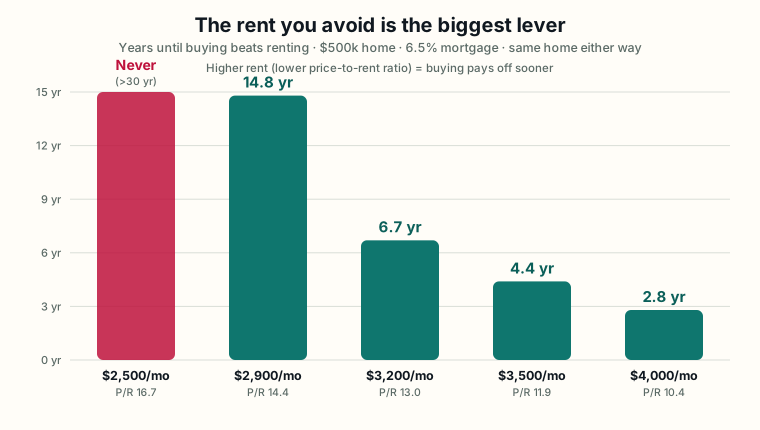
Same house, same rate — only the rent changes. When renting the equivalent home is cheap relative to its price, the renter's invested savings are nearly impossible to beat. When rent is high, buying pays off quickly.
This is why the same advice can't apply everywhere. In an expensive coastal market where a $500,000-equivalent home rents for $2,500, buying may never catch up. In a market where that home rents for $3,500+, buying breaks even in under five years.
2. The mortgage rate
Each percentage point of rate adds to the buyer's cost and pushes break-even out. Holding rent at $3,200:
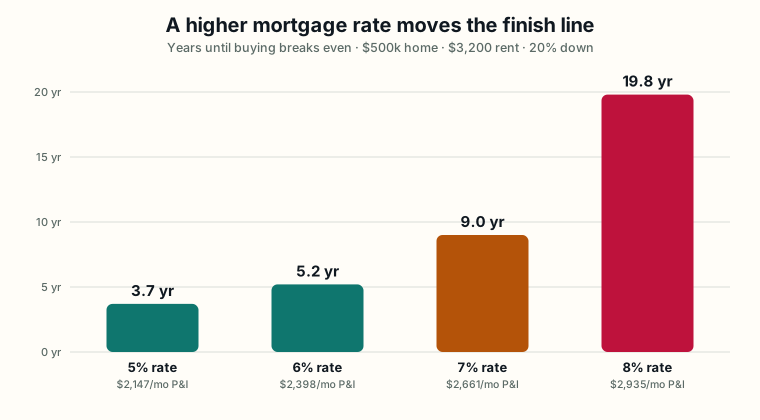
Today's ~6.5% rate sits between the 6% and 7% bars — which is exactly why our scenario breaks even near 6.7 years. If rates fall a point, the same purchase pays off years sooner.
3. What the renter does with the savings
The renter only wins by investing the down payment and the monthly difference. Change the assumed return and break-even moves:
| Renter's investment return | Break-even year (6.5% rate, $3,200 rent) |
|---|---|
| 5% (conservative) | ~4.9 years |
| 7% (moderate) | ~6.7 years |
| 9% (aggressive) | ~15.1 years |
Notice how uneven that jump is. Below about 7%, each extra point of return only pushes break-even out modestly. Above it, the effect snowballs: 7.5% lands near 7.5 years, 8% near 8.6, 8.5% near 10.4, and 9% all the way out to about 15 years. Break-even is hyper-sensitive to the renter's return once it clears the mortgage rate by a couple of points — a renter who can reliably earn aggressive returns changes the math far more than the tidy row spacing suggests.
If the "renter" actually spends the difference instead of investing it, there's no contest — buying wins easily, because forced mortgage savings beat spending. The rent-vs-buy case for renting lives or dies on that discipline.
Common Mistakes
- Comparing rent to the mortgage payment only. Owning also means property tax, insurance, and maintenance — often another $1,000+ a month on a $500,000 home. Compare all-in costs.
- Forgetting the cost of selling. Agent commissions and fees commonly run ~6% of the sale price. That's why a 2–3 year stay rarely pays off.
- Ignoring the opportunity cost of the down payment. $100,000 sitting in home equity is $100,000 not compounding in the market. The calculator counts it; rules of thumb don't.
- Assuming aggressive appreciation. Buying shouldn't depend on the home rising 6–7% a year. Use a conservative figure and let the result stand on its own.
- Treating a rule of thumb as the answer. "Buy if you'll stay 5 years" is a slogan, not a calculation. Your real number depends on your rent, rate, and market.
Make the Example Your Own
Start from the article assumptions, then test these versions:
- Set the rent to your actual rent for an equivalent home. This single number moves the answer more than any other.
- Drop the years-staying dial to 3 and watch how much renting wins if you might move early.
- Try a lower mortgage rate to see how much "waiting for rates" would change things.
- Lower the investment return to 5% to pressure-test the renter's side honestly.
If you're still saving for the down payment, start with a Savings Plan, then come back and run the comparison. If you've already decided to buy, the Home Buyer calculator helps size the payment.
A Note on Assumptions
Every number in this article comes from the same month-by-month model the calculator uses, with the inputs listed above. Real life is messier: rents and home prices don't move in smooth lines, maintenance arrives in lumps, and your time horizon may change. Treat the break-even year as a well-reasoned starting point, then make it yours by entering your real numbers.
Sources
- Freddie Mac: Primary Mortgage Market Survey
- Consumer Financial Protection Bureau: Compare Loan Estimates
- FHFA: House Price Index
- Investor.gov: Compound Interest Calculator
This article is educational and not personalized financial advice.
Related
- The Price-to-Rent Ratio, Explained for Normal People — screen the market before you model the exact break-even year
- Why Buying Is Not Always Cheaper Than Renting — the renter-side counterpoint: when renting and investing the difference can stay ahead for decades
- Rent vs. Buy Calculator — run your own break-even
- Home Buyer calculator — size the monthly payment
- Home Purchase & Sale Planner — budget the closing costs and deadlines
- Savings Plan — how much to set aside each month
More Rent vs Buy Calculator articles
Practical examples that connect the calculator to real planning decisions.
Why Buying Is Not Always Cheaper Than Renting
Buying is not always cheaper than renting. See a concrete 2026 rent-vs-buy scenario where renting and investing the difference can stay ahead for decades.
The Price-to-Rent Ratio, Explained for Normal People
Learn the price-to-rent ratio formula, see a 2026 example, and test whether buying or renting looks stronger in the Rent vs. Buy Calculator.