The price-to-rent ratio sounds like a real estate statistic, but it answers a very personal question: is the home price high or low compared with what it would cost to rent a similar place?
That comparison matters because the rent-vs-buy decision is not just "Can I afford the mortgage?" It is "Would buying leave me with more net worth than renting and investing the cash I did not put into the house?"
The short version:
- Price-to-rent ratio = home price divided by annual rent.
- A lower ratio usually makes buying look better. Rent is expensive compared with the home price, so ownership has less to beat.
- A higher ratio usually makes renting look better. The home is expensive compared with rent, so the renter can invest more cash outside the house.
- The ratio is a shortcut, not the answer. Mortgage rate, down payment, selling costs, maintenance, rent growth, investment return, and how long you stay can all flip the result.
What the Ratio Means
The formula is simple:
price-to-rent ratio = home price / (monthly rent x 12)Suppose a home costs $500,000 and an equivalent rental costs $3,200 per month.
$500,000 / ($3,200 x 12) = 13.0That means the home costs about 13 years of rent.
People often use rough thresholds:
| Price-to-rent ratio | What it often suggests |
|---|---|
| Under 15 | Buying may be competitive |
| 15 to 20 | Run the full numbers |
| Over 20 | Renting often has a strong case |
Those thresholds are useful, but they are not laws. A ratio of 13 can still favor renting if the mortgage rate is high and you might move soon. A ratio of 17 can still favor buying if you stay a long time, rents grow quickly, or you have unusually low ownership costs.
Why the Ratio Matters
Buying has two big costs that renting does not:
- Upfront cash: down payment plus closing costs.
- Exit friction: selling costs when you move.
Renting has a different opportunity:
- Keep the down payment invested.
- Invest any month where renting costs less than owning.
- Stay flexible if life changes.
The price-to-rent ratio is powerful because it captures the biggest tension in one number. If rent is high relative to the home price, buying catches up faster. If rent is low relative to the home price, the renter's invested cash can stay ahead for years.
That is why two households can both say "I am comparing a $500,000 home" and get different answers. The household paying $2,500 rent is in a very different decision than the household paying $4,000 rent.
A Concrete 2026 Scenario
Here is the base case we will use:
| Input | Value |
|---|---|
| Home price | $500,000 |
| Starting monthly rent | $3,200 |
| Down payment | 20% ($100,000) |
| Mortgage | 30-year fixed at 6.5% |
| Closing costs / selling costs | 3% / 6% |
| Home appreciation | 3% per year |
| Rent growth | 3% per year |
| Renter investment return | 7% per year |
| Property tax, insurance, maintenance | Plan in 30 default values for a $500,000 home |
Open the prefilled price-to-rent scenario to start with the assumptions above, then map the rent, home price, mortgage rate, investment return, ownership costs, and years staying to your situation.
Now change only the rent. The home price stays fixed at $500,000.
| Monthly rent | Price-to-rent ratio | What the calculator shows |
|---|---|---|
| $2,500 | 16.7 | Buying does not break even within 30 years |
| $2,900 | 14.4 | Buying breaks even around year 14.8 |
| $3,200 | 13.0 | Buying breaks even around year 6.7 |
| $3,500 | 11.9 | Buying breaks even around year 4.4 |
| $4,000 | 10.4 | Buying breaks even around year 2.8 |
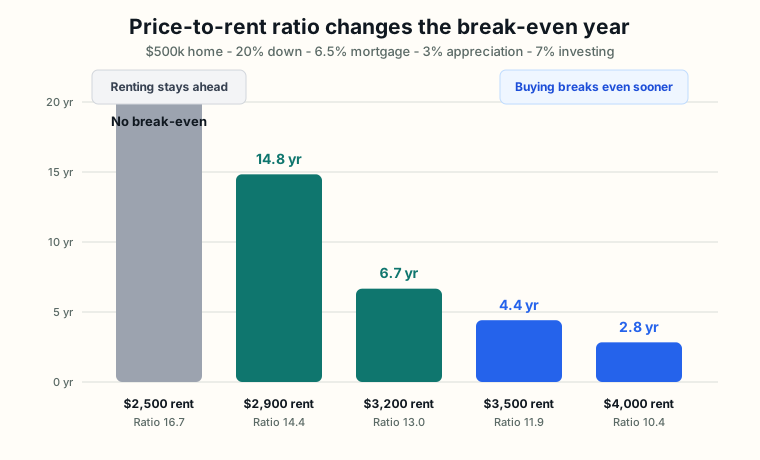
Same home, same down payment, same mortgage rate. The only thing that changes is the rent for an equivalent home. That one input moves the result from "renting wins for decades" to "buying can pay off in under three years."
The Ratio in Plain English
Think of the ratio as a pressure gauge.
When the ratio is high, the buyer is paying a lot for each dollar of rent they avoid. A $500,000 home with $2,000 rent has a ratio of 20.8. In that scenario, the renter keeps a large down payment invested and pays relatively cheap rent. Buying has a hard time catching up.
When the ratio is low, rent is expensive compared with the home price. A $500,000 home with $4,000 rent has a ratio of 10.4. In that scenario, the buyer's fixed mortgage starts looking competitive quickly because rent is already high and grows over time.
The ratio does not say owning is morally better or renting is financially weaker. It just says how hard buying has to work to beat renting and investing.
Where the Shortcut Breaks
The price-to-rent ratio ignores several things that can matter a lot.
Mortgage rate
The ratio does not know whether your mortgage is 5%, 6.5%, or 8%. A lower rate gives buying a tailwind. A higher rate pushes the break-even year out.
That is why a ratio that looked buyer-friendly in a low-rate market can look much less friendly when rates rise. The rent number did not change, but the cost of financing did.
Time horizon
The ratio also does not know whether you will stay for three years or twelve.
Short stays punish buyers because closing costs and selling costs hit before equity has time to build. Even a low ratio can favor renting if you might move soon.
Maintenance and local taxes
Two $500,000 homes can have very different owner costs. Property tax, homeowners insurance, HOA fees, and maintenance change the monthly comparison. A condo with a high HOA can behave very differently from a house with low fixed costs.
The renter's discipline
Renting only wins the net-worth comparison if the renter invests the down payment and the monthly savings. If the renter spends the difference, the math changes. The calculator assumes the renter invests the difference because that is the fairest comparison against mortgage principal and home equity.
Home appreciation
The ratio says nothing about future home-price growth. Appreciation can help buying, but it is uncertain and local. Do not make buying work only by assuming unusually high appreciation.
Common Mistakes
- Using the ratio as the final answer. It is a screening tool. The final answer comes from a full rent-vs-buy model.
- Comparing rent to principal and interest only. Owners also pay property tax, insurance, maintenance, HOA fees, and selling costs.
- Using rent for a non-equivalent home. Compare the home you would buy with the kind of home you would actually rent.
- Forgetting the invested down payment. The renter's side should include the cash that did not go into the house.
- Ignoring how long you will stay. Transaction costs make the first few years unusually important.
Make the Example Your Own
Start from the article assumptions, then test these versions:
- Try $2,500 rent to see why a high price-to-rent ratio can keep renting ahead.
- Keep $3,200 rent as the middle case where buying needs about seven years.
- Try $4,000 rent to see how expensive rent can make buying catch up quickly.
- Change the mortgage rate to your real quote before trusting the break-even year.
- Shorten the stay to 3 years if you may move before transaction costs have time to amortize.
If you are still building the down payment, use the Savings Plan first. If you are already shopping, the Home Buyer calculator can help size the full monthly payment before you compare it with rent.
Sources and Assumptions
The scenario results above come from the same month-by-month model used by the Plan in 30 Rent vs. Buy Calculator. The model compares owner net worth against renter net worth after mortgage amortization, home appreciation, ownership costs, rent growth, selling costs, and investing the renter's available cash.
For broader context, the Consumer Financial Protection Bureau home buying guide is a useful source for mortgage and closing-cost basics, and Freddie Mac's Primary Mortgage Market Survey is a standard place to check current mortgage-rate context. Zillow's public buy-versus-rent break-even methodology is also helpful for understanding why time horizon and invested renter cash matter.
This article is educational and not personalized financial advice. Treat the ratio as a first-pass filter, then run your real numbers before deciding.
Related
- Why Buying Isn't Always Cheaper Than Renting - see why a lower payment can still lose once full ownership costs and invested renter cash are included
- Rent vs. Buy: How to Find Your Break-Even Point (2026)
- Rent vs. Buy Calculator
- Home Buyer calculator
- Savings Plan
More Rent vs Buy Calculator articles
Practical examples that connect the calculator to real planning decisions.
Why Buying Is Not Always Cheaper Than Renting
Buying is not always cheaper than renting. See a concrete 2026 rent-vs-buy scenario where renting and investing the difference can stay ahead for decades.
Rent vs. Buy: How to Find Your Break-Even Point (2026)
Find your rent-vs-buy break-even year with a worked 2026 scenario and the three levers that most change the result.