A credit card balance does not shrink by the amount you send in each month. Interest gets added first. Then the rest of your payment reduces principal.
That is why the useful question is not just "Can I afford the payment?" The useful question is:
What payoff date and total interest am I buying with this payment?
Short Answer
For an $8,000 credit card balance at 22% APR, here is the difference between three fixed monthly payments, assuming no new purchases and no fees:
| Monthly payment | Payoff time | Estimated interest | Total paid |
|---|---|---|---|
| $250 | 49 months | ~$4,160 | ~$12,160 |
| $400 | 26 months | ~$2,060 | ~$10,060 |
| $600 | 16 months | ~$1,260 | ~$9,260 |
The $400 payment is only $150 more than the $250 payment, but it cuts the timeline by almost two years and saves about $2,100 of interest in this example.
What Makes Credit Card Payoff Slow
A credit card APR is annual, but interest usually builds inside each monthly billing cycle. A simple monthly estimate divides the APR by 12.
With a 22% APR, the monthly rate is about 1.83%. On an $8,000 balance, the first month starts with roughly $147 of interest.
So if you pay $250, the first payment is not really a $250 balance reduction:
| First month item | Amount |
|---|---|
| Starting balance | $8,000 |
| Estimated interest | $147 |
| Payment | $250 |
| Principal reduction | $103 |
| Ending balance | $7,897 |
That first month is the lesson. The payment matters, but the part of the payment that reaches principal matters more.
The Calculator Experiment
Imagine Maya has one credit card:
| Input | Value |
|---|---|
| Balance | $8,000 |
| APR | 22% |
| New purchases | $0 |
| Extra fees | $0 |
| Goal | Pay the balance to $0 |
She tests three fixed payments in the Debt-Free Planner.
Open the prefilled Maya credit card payoff scenario to start with the $8,000 balance, 22% APR, and $400 monthly payment, then map the balance, APR, and payment to your situation.
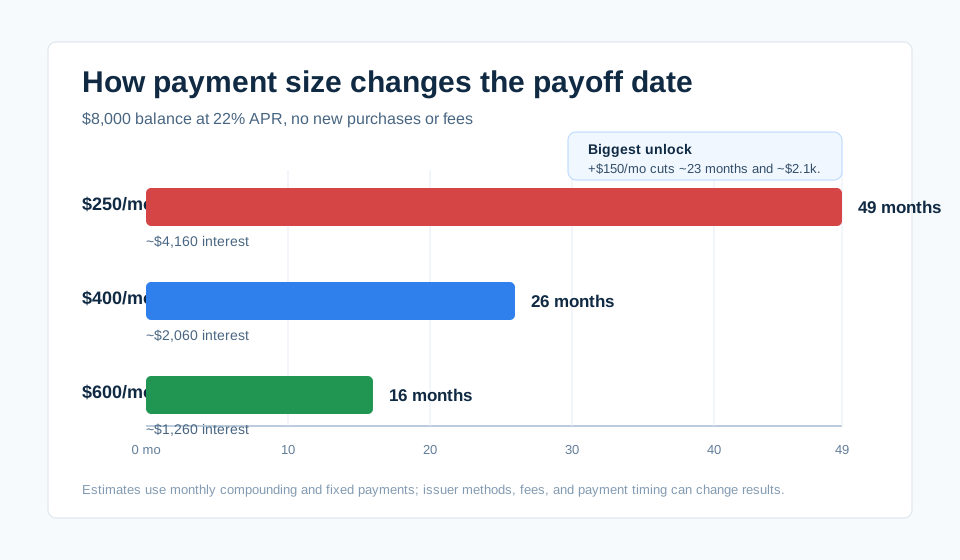
The jump from $250 to $400 is the biggest practical unlock. It shortens the plan from 49 months to 26 months. The jump from $400 to $600 still helps, but the gain is smaller because the plan is already moving quickly.
Why Your Statement Shows a 3-Year Number
Credit card statements include repayment disclosures. The Consumer Financial Protection Bureau explains that issuers must show how long payoff would take if you made no new charges and paid only the minimum due, and they must also show the monthly payment needed to pay the current balance in 36 months.
For Maya's example, the rough 36-month fixed payment is about $306 per month at 22% APR. That would cost about $3,000 in interest.
That number is useful, but it is not a promise that your balance will be gone in three years if you keep using the card. New purchases, fees, missed payments, rate changes, and promotional-rate rules can all change the answer.
Minimum Payments Are Not a Payoff Plan
Minimum payments keep the account current, which matters. But they are usually designed as a floor, not a fast payoff strategy.
The CFPB's 2025 credit card market report describes common minimum-payment formulas as a fixed floor or a percentage of the balance plus interest and fees. That structure can make the required payment fall as the balance falls, which means progress can stay slow unless you choose a fixed payoff payment.
A better planning habit is:
- Make at least every required minimum on time.
- Pick a fixed monthly payoff amount you can actually sustain.
- Stop adding new charges to the payoff card if possible.
- Recalculate after any month where the payment, APR, balance, or fees change.
How to Estimate Your Own Payoff Date
Use this simple sequence before deciding on a payment:
| Step | What to enter | Why it matters |
|---|---|---|
| 1 | Current balance | The payoff plan starts from today's actual number, not last month's memory. |
| 2 | APR | Higher APR means more of each payment goes to interest first. |
| 3 | Required minimum | You need this to stay current while planning extra payoff. |
| 4 | Fixed monthly payment | This is the number that controls the payoff date. |
| 5 | New purchases | A payoff plan breaks if the balance keeps getting rebuilt. |
Then test one change at a time. Do not change the APR, payment, and spending assumption all at once, or you will not know which lever improved the plan.
A Practical Payment Rule
If the minimum is all you can pay, pay it on time and stabilize the rest of the budget first. But once you have room, aim for a payment that makes the balance visibly fall every month after interest.
For Maya, the first month looks like this:
| Payment | First-month interest | First-month principal | What it feels like |
|---|---|---|---|
| $250 | ~$147 | ~$103 | Slow but moving |
| $400 | ~$147 | ~$253 | Balance starts dropping clearly |
| $600 | ~$147 | ~$453 | Aggressive payoff mode |
A useful target is a payment where at least half of the first payment goes to principal. That is not a formal rule, but it is a good gut check. If interest eats most of the payment, the plan may feel discouraging.
When to Consider a Different Strategy
A fixed payoff plan is not always enough. Consider another path when:
- You cannot cover required minimums.
- The payoff timeline is longer than five years even with a serious payment.
- The APR is so high that the balance barely moves.
- A hardship plan, nonprofit credit counseling, balance transfer, or consolidation offer could lower cost without adding worse risks.
- You are still using the same card because the budget has no cushion.
The Federal Trade Commission advises consumers who are behind to contact the credit card company directly and ask about a lower rate or payment plan before paying a company to negotiate for them. That does not mean every issuer will agree, but the first call should not cost you an upfront fee.
Make the Example Your Own
Start from Maya's $400 baseline, then test three versions:
- Lower the payment to $250 and note how much longer the plan lasts.
- Keep $400 and compare the first six projected balances.
- Raise the payment to $600 and decide whether the faster finish is worth the cash-flow pressure.
Compare payoff date, total interest, and the first-month principal reduction before choosing a fixed payment.
Related Planning Steps
- If minimum payments are why the timeline looks stuck, read Why Minimum Payments Keep You in Debt Longer.
- If you have several balances, compare payoff order with Debt Snowball vs Avalanche.
- If paying more would leave you with no cash cushion, set a starter-reserve target with the Savings Plan.
- If known annual expenses keep landing on the card, use the Savings Goal Planner to set aside money before the bill arrives.
Bottom Line
Your payoff date is not fixed. It is the result of the balance, APR, payment, fees, and whether new purchases keep appearing.
For an $8,000 card at 22% APR, a $250 payment takes about four years. A $400 payment cuts that to a little over two years. A $600 payment can finish in about 16 months.
Start with the number you can sustain, then test what a little more would buy. The best payment is not the biggest number you can force for one month. It is the number that gets repeated until the balance reaches zero.
This article is educational planning content, not personalized financial, legal, credit, or debt counseling advice. Your payoff result depends on your issuer's terms, APR, fees, payment timing, and whether you make new purchases.
Sources
- Consumer Financial Protection Bureau, Credit card statement 3-year payoff disclosure.
- Consumer Financial Protection Bureau, Understanding minimum payments.
- Consumer Financial Protection Bureau, The Consumer Credit Card Market, 2025.
- Federal Trade Commission, Using Credit Cards and Disputing Charges.
- Federal Trade Commission, How To Get Out of Debt.
- Federal Reserve, Consumer Credit - G.19.
More Debt-Free Planner articles
Practical examples that connect the calculator to real planning decisions.
Why Minimum Payments Keep You in Debt Longer Than You Think
See why credit card minimum payments can stretch a $6,000 balance for years, and how fixed monthly payments change the payoff date and interest cost.
Debt Snowball vs Avalanche: Which Payoff Method Should You Use?
Compare debt snowball and avalanche with a payoff scenario, interest estimate, first-win timeline, and calculator steps for choosing your method.