Debt payoff advice usually splits into two camps. One says to attack the smallest balance first so you get a quick win. The other says to attack the highest interest rate first so less money leaks to lenders.
Both methods can work. The better question is not which method sounds smarter. It is:
Which method gets you to zero with the least regret and the highest chance that you will keep going?
Short Answer
Use the debt avalanche if you can stay motivated by the math. It targets the highest APR first, so it usually saves the most interest.
Use the debt snowball if quick wins help you stay engaged. It targets the smallest balance first, so you may see a debt disappear sooner, even if total interest is higher.
In the worked example below, both plans erase the same $22,500 of debt with a $1,100 monthly debt budget. The avalanche pays everything off in about 25 months with about $4,100 of interest. The snowball gives the first win sooner, but finishes around 27 months with about $6,400 of interest.
That is the tradeoff: the snowball buys momentum. In this example, the price of that momentum is about $2,200 of extra interest and roughly two extra months.
What the Two Methods Mean
The Consumer Financial Protection Bureau describes two basic debt-reduction approaches: a highest-interest-rate method and a snowball method. Both start with the same foundation: keep making the required payments on every debt, then send extra dollars to one priority debt.
| Method | First target | Main advantage | Main tradeoff |
|---|---|---|---|
| Debt avalanche | Highest APR | Usually minimizes interest | First payoff can take longer |
| Debt snowball | Smallest balance | Creates faster visible wins | Can cost more interest |
In plain English:
- Avalanche asks, "Which balance is costing me the most right now?"
- Snowball asks, "Which balance can I eliminate first?"
Neither method excuses missed minimum payments. Those come first. The method decides where the extra payoff money goes after the required payments are covered.
A Real Payoff Scenario
Imagine Jordan has four debts and can commit $1,100 per month toward debt payments. The required minimums total $650, which is useful for checking that the payoff budget is realistic. The calculator experiment below focuses on how the same $1,100 monthly payoff budget moves through the debt list under each payoff-order rule.
| Debt | Balance | APR | Required payment |
|---|---|---|---|
| Medical bill | $900 | 0% | $50 |
| Store card | $1,200 | 29.99% | $40 |
| Credit card | $12,000 | 24.99% | $280 |
| Personal loan | $8,400 | 12.50% | $280 |
| Total | $22,500 | $650 |
The debt snowball starts with the $900 medical bill because it is the smallest balance. The debt avalanche starts with the 29.99% store card, then moves to the 24.99% credit card before lower-rate balances.
Open the prefilled Jordan payoff-order scenario to start with the balances, APRs, and $1,100 payoff budget above, then map the debt list, rates, payment amount, and payoff-order strategy to your situation.
The Calculator Experiment
Here is what happens when the same monthly debt budget is routed two ways.
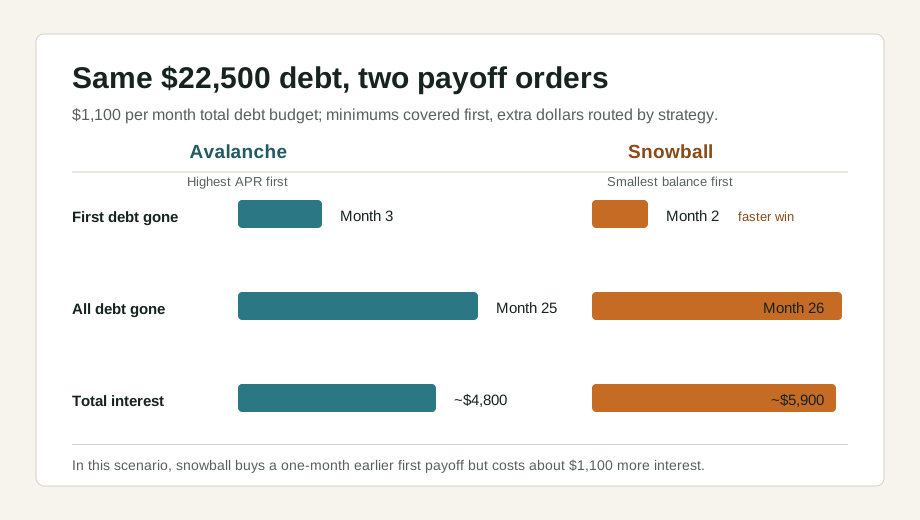
| Result | Avalanche | Snowball |
|---|---|---|
| First debt gone | Month 2 | Month 1 |
| All debt gone | Month 25 | Month 27 |
| Estimated total interest | ~$4,100 | ~$6,400 |
| Interest difference | Baseline | About $2,200 more |
The snowball feels better quickly because the medical bill disappears first. That can matter. Paying off one account can turn a messy list into a smaller, cleaner list.
But the avalanche attacks the high-rate store card and credit card sooner. That matters too, because a 24.99% or 29.99% APR balance compounds while you wait. The Federal Reserve's latest credit-card profitability report notes that average rates on accounts assessed interest were about 22.8% at the end of 2024, and actual card rates vary widely by borrower and product. At rates like that, the order of attack can change real dollars.
When Avalanche Is the Better Fit
Avalanche is usually the better fit when:
- Your highest-rate debt is large.
- The interest-rate gap between debts is wide.
- You can stay motivated by seeing total interest fall.
- You want the mathematically cheaper path.
- You are already comfortable tracking balances month by month.
The SEC's Investor.gov guidance is blunt about high-interest debt: eliminating it can be more valuable than chasing investment returns because the avoided interest is certain. That does not mean every low-rate loan should be rushed, but expensive credit-card debt usually deserves priority once your basic cash cushion is stable.
When Snowball Is the Better Fit
Snowball is usually the better fit when:
- You have several small balances cluttering your plan.
- You have quit payoff plans before because progress felt invisible.
- The interest-rate differences are small.
- The smallest balances are also high-rate debts.
- You need fewer accounts and simpler monthly administration.
The snowball is not "bad math" if it keeps you in the game. A perfect spreadsheet that you abandon in month four is worse than a slightly more expensive plan you finish.
The Decision Rule
Use this practical filter:
| Your situation | Start with |
|---|---|
| One card is much higher APR than everything else | Avalanche |
| Small debts are creating stress and decision fatigue | Snowball |
| You are already disciplined and want lowest cost | Avalanche |
| You need a visible win in the next 30-90 days | Snowball |
| The interest difference is small either way | Pick the method you will stick with |
| You cannot cover required payments | Pause strategy talk and stabilize bills first |
If you are unsure, run both. The "right" method often becomes obvious when you see the price of choosing motivation over interest savings.
Common Mistakes
Paying extra before covering every minimum
Every plan starts by keeping each account current. Extra principal payments help only after required payments, housing, utilities, food, insurance, and transportation are stable.
Comparing only the first payoff
The first win matters, but it is not the whole plan. In Jordan's case, the snowball wins the first-payoff race by one month, but costs about $2,200 more overall.
Ignoring very high APRs
A 0% medical bill and a 29.99% store card are not equal. The store card grows every month. If a low-rate small balance is blocking a high-rate large balance for too long, the snowball can get expensive.
Switching methods every month
Changing strategy is fine when your facts change. Switching because you are bored usually slows the plan down. Pick the rule, track actual balances, and revisit only at checkpoints.
Forgetting the emergency cushion
Debt payoff should not leave you one surprise bill away from new credit-card debt. If you have no cash at all, build a small starter cushion first, then attack expensive debt.
Make the Example Your Own
Start from Jordan's balances, then test three versions:
- Keep Avalanche selected and note the payoff date and projected interest.
- Switch to Snowball and compare the first payoff, final payoff, and interest.
- Raise and lower the monthly payment by $100 to see whether the tradeoff is still worth it.
Compare payoff date, total interest, and which debt disappears first before choosing the method you will actually follow.
Related Planning Steps
- If you want to test how a higher payment changes the payoff date, read How Long Will It Take to Pay Off My Credit Card?.
- If you need the motivation case for paying more than the minimum, read Why Minimum Payments Keep You in Debt Longer.
- If you have almost no cash, use the Savings Plan to set a starter-cushion target before going all-in on payoff.
- If the monthly payment feels too high, use the Savings Goal Planner for known expenses so they do not land back on a card.
- If your debt load would take more than five years even with a serious payment, review nonprofit credit counseling resources before paying any debt relief company upfront.
Bottom Line
Avalanche is usually cheaper. Snowball is often easier to keep following. The best payoff method is the one that gets your real balances to zero without creating new debt along the way.
Start with the math, but do not ignore behavior. If the avalanche saves thousands, it is hard to justify delaying it. If the snowball costs a small amount and gives you the momentum to finish, that can be a rational choice too.
This article is educational planning content, not personalized financial, legal, or credit counseling advice. Your payoff result depends on your actual balances, APRs, required payments, fees, and whether rates or payments change.
Sources
- Consumer Financial Protection Bureau, Debt reduction worksheet.
- Consumer Financial Protection Bureau, How to reduce your debt.
- Consumer Financial Protection Bureau, Regulation Z payment allocation rule.
- Investor.gov, Pay Off Credit Cards or Other High Interest Debt.
- Federal Reserve, Profitability of Credit Card Operations of Depository Institutions, November 2025.
- Fidelity, Debt snowball method vs. debt avalanche method.
- Federal Trade Commission, How To Get Out of Debt.
More Debt-Free Planner articles
Practical examples that connect the calculator to real planning decisions.
Why Minimum Payments Keep You in Debt Longer Than You Think
See why credit card minimum payments can stretch a $6,000 balance for years, and how fixed monthly payments change the payoff date and interest cost.
How Long Will It Take to Pay Off My Credit Card?
See how long an $8,000 credit card balance takes to pay off at 22% APR with $250, $400, or $600 monthly payments, plus steps to test your own payoff date.