Short Answer
"Financial advisor" is not one job — it's at least six. The right question isn't *whether* to hire one, it's *which* professionals your situation actually calls for, and in what order.
For most people the honest answer is a small team, not a single person: usually a planner or investment manager, often a tax professional, and — once you have kids, property, or a business — an estate attorney and the right insurance.
The fastest way to see your own shortlist is to answer a few questions about your life and finances. The scorecard ranks different professional types from "you need this now" to "not yet." This article walks one real family through that scorecard so you can read your own.
What "Financial Advisor" Actually Means
When people say "I should talk to a financial advisor," they usually picture one person who does everything. In reality the work splits into six different jobs, and no single credential covers all of them.
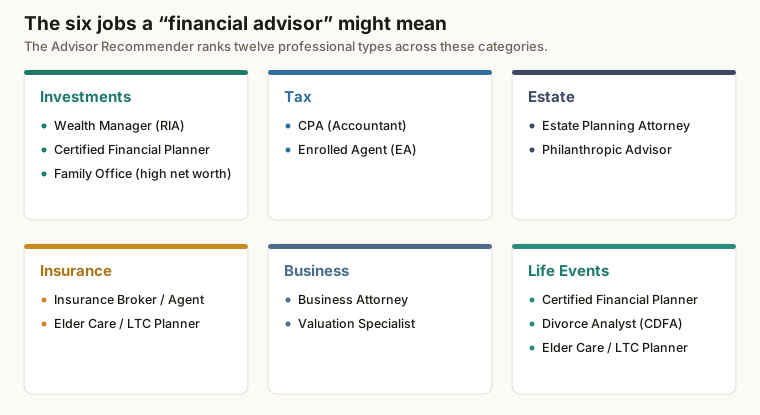
*The twelve professional types the Advisor Recommender ranks, grouped by the job they do.*
A quick translation of the alphabet soup:
- Wealth Manager (RIA) — manages your investment portfolio as a fiduciary (legally required to put your interests first).
- Certified Financial Planner (CFP) — the generalist "quarterback" who builds a coordinated plan across investments, retirement, taxes, insurance, and estate.
- CPA / Enrolled Agent (EA) — tax preparation and planning. A CPA is the broader credential; an EA is a federally licensed tax specialist, usually a bit cheaper.
- Estate Planning Attorney — drafts your will, trusts, powers of attorney, and names guardians for your kids.
- Insurance Broker — shops life, disability, and umbrella coverage to protect your income and assets.
- Specialists — business attorney, valuation expert, divorce financial analyst (CDFA), elder-care planner, and philanthropic advisor each handle one specific situation.
You don't need all of them. You need the two to four that match where you are right now.
Why It Matters
Hiring the wrong type wastes money; hiring no one leaves real gaps. A new parent who hires an investment manager but never sees an estate attorney has a growing portfolio and no guardian named for their children. A business owner who has a great CPA but no business attorney can sail into a partnership dispute with nothing in writing.
Getting the *type* right is also how you avoid overpaying. Advisors are not interchangeable, and their fees work in completely different ways — a percentage of your assets, a flat project fee, an hourly rate, or a commission paid by a product company. Match the job to the person and you pay for what you need, once.
Example Scenario: The Patel Family
Let's make it concrete with one of the Advisor Recommender's built-in example profiles, "Family with Kids." Meet the Patels:
- Married, two kids
- Net worth: $1M–$5M (home equity plus retirement and brokerage accounts)
- Income: $250k–$500k, mostly W-2 plus a small side income
- Equity compensation: yes (RSUs from one spouse's employer)
- Real estate: one home
- A nagging worry: if one of them died, would the other and the kids be okay?
That last point matters as much as the dollar figures. Now here is what the recommender returns when it scores the Patels' situation:
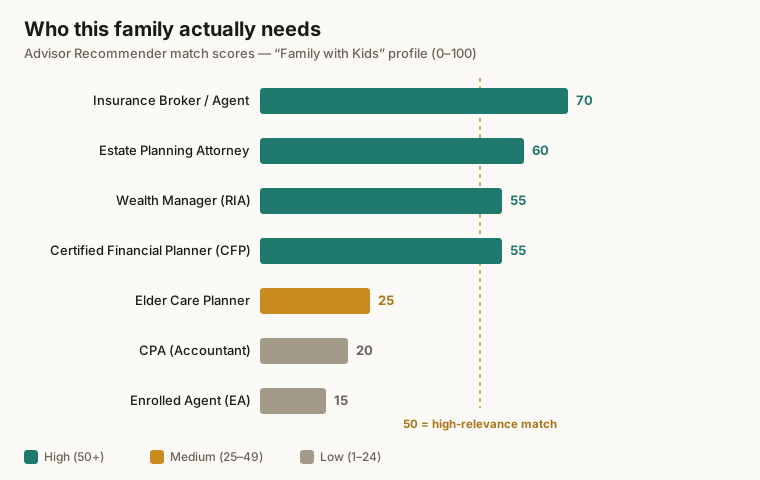
*Four high-relevance matches, across three different jobs. The vertical line marks the 50-point "high match" threshold.*
The headline result is probably not what they expected. The top match isn't an investment manager — it's an insurance broker.
What the Recommender Shows
The tool doesn't just rank advisors; it shows *why* each one fired. Every match is the sum of weighted rules that match your situation:
| Advisor type | Score | Why it matched |
|---|---|---|
| Insurance Broker / Agent | 70 | Insurance concern (+40), has children (+20), moderate+ net worth (+10) |
| Estate Planning Attorney | 60 | Has children (+25), moderate+ net worth (+15), owns real estate (+10), married (+10) |
| Wealth Manager (RIA) | 55 | Moderate+ net worth (+30), equity compensation (+25) |
| Certified Financial Planner (CFP) | 55 | Moderate+ net worth (+25), equity compensation (+20), has children (+10) |
| Elder Care Planner | 25 | Life-insurance concern (+15), moderate net worth (+10) |
| CPA | 20 | Equity compensation (+20) |
| Enrolled Agent (EA) | 15 | Moderate income (+15) |
Open the prefilled Patel advisor match scenario to start with the married-with-kids profile, then map the family, income, net worth, insurance, and life-event fields to your situation.
Read that top row again: the insurance broker scores highest because a young family that depends on two incomes has the most to lose and often the least protection in place. It's the classic blind spot — easy to postpone, expensive to skip. The estate attorney is right behind for the same reason: with two kids and a house, the Patels need a will, guardianship, and powers of attorney far more urgently than they need a cleverer portfolio.
How to Read the Scores
The number is a priority signal, not a grade. Use the tiers:
- High (50+) — address these now. For the Patels, that's insurance, estate documents, and a planner or investment manager.
- Medium (25–49) — worth doing, but not this month. These often become "high" after a life event.
- Low (1–24) — keep on the radar; act when your situation changes.
Be a little skeptical of weak signals. The Patels' "Elder Care Planner — 25" is borderline, driven mostly by the same insurance flag and their net worth — not a sign they need long-term-care planning at mid-career. A score is a prompt to look, not a command to hire. That CPA showing only 20 is also informative: the Patels' taxes aren't complex *yet* (mostly W-2). The day a spouse goes full-time on the side business, the CPA's score jumps and it moves to the top of the list.
What Changes the Answer
Change the situation and the whole ranking shifts. Here are the Patels next to "Young Professional" — single, $100k–$250k income, some equity comp, and a first home on the horizon:
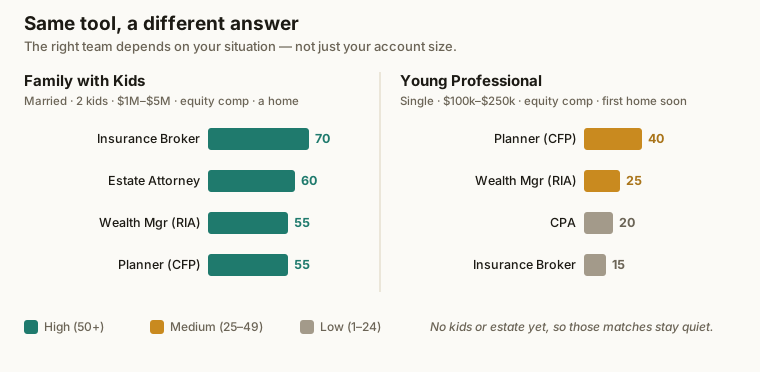
*Same twelve advisors, scored against two lives.*
For the young professional, the CFP leads — a generalist planner makes sense when you're setting the foundation, the equity comp needs a strategy, and a home purchase is coming. There's no estate attorney match at all yet (no kids, no real estate), and the insurance broker is a low-priority footnote rather than the #1 need. Nothing changed about the tool. Everything changed about the situation.
This is the real lesson: the right team isn't decided by how much money you have. It's decided by what's going on in your life — dependents, property, a business, a complicated tax year, or a life event on the horizon.
What Your Top Matches Cost
Fees work differently for each type, which is exactly why matching the job matters. These are typical ranges:
For a deeper cost breakdown, pair this with How Much Does a Financial Advisor Cost in 2026?, which explains AUM, flat-fee, hourly, and commission models in more detail.
| Advisor type | How they charge | Typical cost |
|---|---|---|
| Insurance Broker | Commission (paid by the carrier) | Often no direct fee; fee-only analysis $1,000–$3,000 |
| Estate Planning Attorney | Flat fee per package | $1,500–$3,500 basic; $5,000–$15,000+ complex |
| Wealth Manager (RIA) | % of assets managed (AUM) | 0.25%–1.5%/yr; often ~1% under $1M |
| Certified Financial Planner | AUM, flat, or hourly | 0.5%–1.25% AUM; or $2,000–$7,500 flat plan |
| CPA | Flat fee per return | $300–$800 basic; $1,000–$5,000+ complex |
Two things to notice. First, "1% of assets" sounds small but compounds: on a $1.2M portfolio that's about $12,000 a year, every year, so it's worth knowing what you get for it. Second, the insurance broker's "free" is paid by commission from the company whose policy you buy — useful, but a reason to get the coverage *amount* right (a fiduciary planner can sanity-check it) before buying the product. The Advisor Recommender shows the fee model alongside each match so the cost is part of the decision, not a surprise later.
Common Mistakes
- Assuming "financial advisor" means "investment manager." For a young family, protection and estate basics often matter more than portfolio tweaks.
- Hiring everyone at once. Start with your high-relevance matches; add specialists as life events arrive.
- Skipping the fiduciary question. Ask directly: "Are you a fiduciary for *this* engagement, and are you fee-only?" RIAs and CFPs doing planning owe a full fiduciary duty; commission-based brokers don't — though since Reg BI took effect in 2020 they do owe a "best interest" standard on retail recommendations, which is real protection but weaker than a fiduciary duty. The bar can vary by role, account, and product, so confirm which one covers your engagement.
- Confusing a CPA with a planner. They do different jobs — taxes vs. wealth and goals — and most households eventually need both.
- Waiting for "enough money." The trigger is usually a change — a baby, a home, an inheritance, a business, a divorce — not a net-worth milestone.
Make the Example Your Own
Start from the Patel family profile, then test three versions:
- Remove the life-insurance concern and see whether protection still ranks first.
- Change the household from married with children to single with a home purchase ahead.
- Add a business sale, inheritance, or parent-care event and see which specialist moves up.
Compare the high-relevance matches, why each one fired, and which fee model you would expect before you call anyone.
The output is educational, not a referral — it tells you *which kind* of professional to research, but it does not verify individual professionals or firms.
Related: How Much Does a Financial Advisor Cost in 2026?
Related Reading
- Trust Advisor — once the recommender flags an estate attorney, use this to understand whether you need a will, a trust, or both before you book the appointment.
- Career Advisor — for the life event that drives many financial decisions: a job or income change.
- Retirement Planner — model the long arc an investment manager would help you navigate, so you arrive at that meeting with a number in mind.
Sources and Notes
- SEC / Investor.gov — Working with an investment professional
- CFP Board — The standard of excellence (the fiduciary duty)
- IRS — Understanding tax return preparer credentials (CPA, EA, attorney)
- Consumer Financial Protection Bureau — What is a fiduciary?
- FINRA — Working with an investment professional
- FINRA — Regulation Best Interest (Reg BI): the broker-dealer "best interest" standard
- NAPFA — What is fee-only financial planning?
This article is educational planning content, not personalized financial, legal, tax, or insurance advice. The Advisor Recommender is a free educational tool that suggests *types* of professional based on the situation you enter; it does not refer specific firms and your own needs may differ. Cost ranges are typical estimates and vary by market and complexity.
More Advisor Recommender articles
Practical examples that connect the calculator to real planning decisions.