Short Answer
A financial advisor can cost nothing as a separate line item, a few hundred dollars, several thousand dollars, or more than $10,000 per year. The answer depends less on the title "financial advisor" and more on three things: the job you need done, the fee model, and how much money or complexity the advisor is responsible for.
A useful starting range:
- Hourly advice: often $150-$500 per hour.
- Flat-fee planning: often $2,000-$7,500 for a plan, with higher retainers for ongoing work.
- AUM portfolio management: often 0.25%-1.5% of assets managed per year.
- Tax prep and planning: often $300-$800 for a basic return, $1,000-$5,000+ for complex work.
- Estate planning: often $1,500-$3,500 for a basic plan, $5,000-$15,000+ for complex work.
- Insurance brokerage: often no direct advisory bill, because the broker is paid by commission from the carrier.
Treat those as screening ranges, not quotes. Before comparing professionals, ask each one for the current written fee schedule, what services are included, and what would cost extra.
A better first step is to figure out *which* professional matches your situation before you compare prices. A $7,500 plan can be reasonable if it solves the right problem; a "free" commission recommendation can be expensive if it pushes the wrong product.
What "Cost" Really Means
There are two costs to separate.
The first is the visible fee: the invoice, hourly bill, retainer, AUM percentage, tax-prep bill, estate-plan package, or commission built into a product. The second is the conflict or opportunity cost: whether the advisor is paid in a way that nudges them toward a product, an ongoing relationship, or a more expensive scope than you need.
That does not mean every commission is bad or every fee-only planner is automatically right. It means you should ask how the professional is paid before you ask whether the price is fair. FINRA's investor guidance notes that investors can face different fee structures depending on account type, services, and products. Investor.gov also emphasizes checking registration and understanding services, fees, and conflicts before choosing an investment professional.
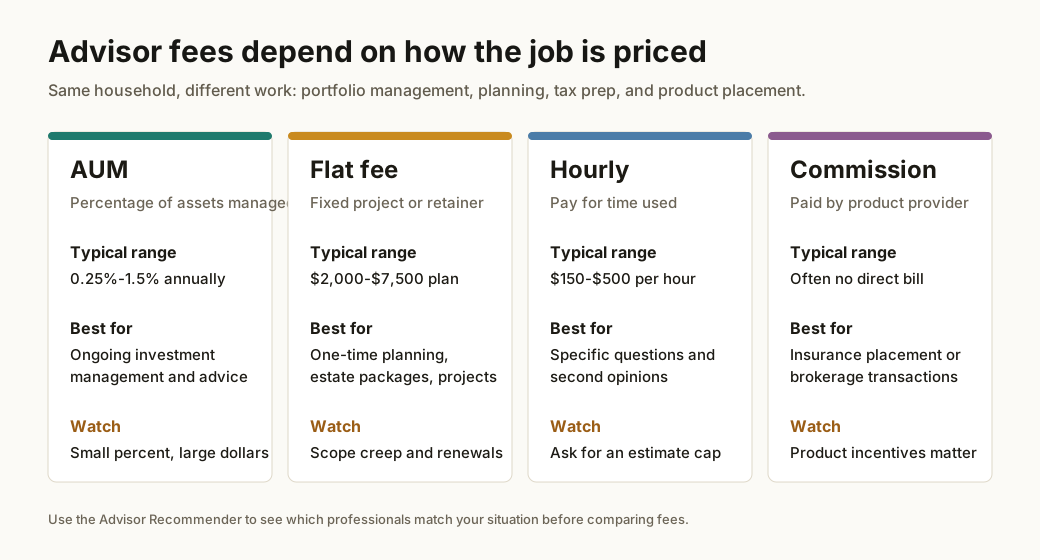
*The same household may need several professional types, each priced differently.*
The Four Main Fee Models
1. AUM: A Percentage of Assets Managed
AUM means "assets under management." If an RIA manages a $1.2 million portfolio and charges 1.00%, the annual advisory fee is about $12,000. It is usually billed quarterly from the account.
That fee may include investment management, rebalancing, tax-loss harvesting, retirement income planning, and access to a planning team. Or it may mostly cover portfolio oversight. The scope matters. A 1.00% fee for comprehensive planning and ongoing coordination is different from 1.00% for a basic model portfolio.
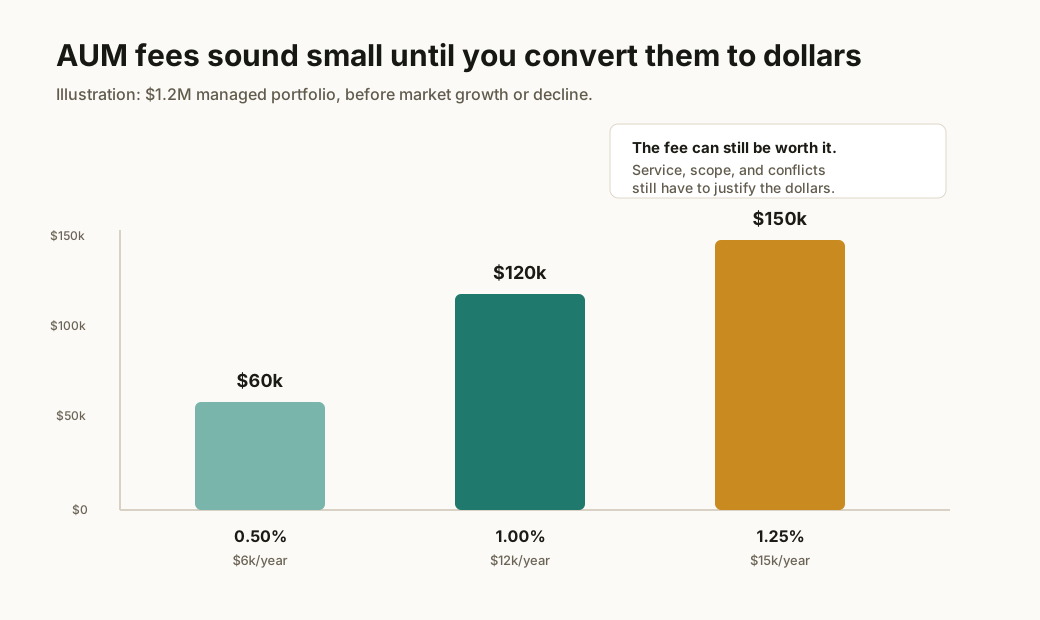
*On $1.2M, a 1.00% AUM fee is about $12,000 per year. Over ten years, before market changes, that is $120,000.*
2. Flat Fee: A Defined Project or Annual Planning Fee
Flat fees are easier to compare because the dollar amount is visible. A CFP professional might charge $2,000-$7,500 for a financial plan. An estate planning attorney might charge $1,500-$3,500 for a basic will, power of attorney, and healthcare directive package, or more for a trust-centered plan.
Flat fees are useful when you know the job: build a retirement plan, review equity compensation, create an estate plan, or answer a defined set of questions. The key is scope. Ask what is included, how many meetings are included, whether implementation help is included, and what happens after the first plan is delivered.
3. Hourly: Pay for Time
Hourly advice is useful for second opinions and focused questions: "Should I roll this 401(k)?", "How should I think about RSUs?", "Can someone check my retirement plan before I make a decision?"
Hourly work can be cost-effective because you do not commit to an ongoing relationship. But open-ended hourly work can drift. Ask for an estimate, a cap, and a written list of deliverables.
4. Commission: Paid by the Product Provider
Insurance brokers and some brokerage relationships are often commission-based. You may not receive an invoice, but the professional is still paid. The money comes from the carrier or product provider, often through first-year and renewal commissions.
That can be perfectly normal for placing term life insurance or shopping carriers. It also creates an incentive to recommend a product, so the best move is to separate the advice from the purchase when the stakes are high. For example, a fee-only planner can help decide *how much* insurance you need before a broker helps find a policy.
Example Scenario: The Patel Family
Use the Advisor Recommender's built-in Family with Kids example. The Patels are married with two children, a home, $1M-$5M net worth, $250k-$500k income, some equity compensation, and a life-insurance concern.
Their top matches are not all investment professionals. The recommender shows a cross-functional team:
| Professional | Why it matched | How it may charge | Planning range to expect |
|---|---|---|---|
| Insurance Broker / Agent | Insurance concern, children, moderate+ net worth | Commission paid by carrier; fee-only analysis is less common | Often no direct advisory bill; fee-only insurance analysis can run $1,000-$3,000 |
| Estate Planning Attorney | Children, real estate, married, moderate+ net worth | Flat package or hourly | $1,500-$3,500 basic; $5,000-$15,000+ complex |
| Wealth Manager (RIA) | Moderate+ net worth, equity compensation | AUM percentage or retainer | 0.25%-1.5% of AUM annually; some retainers $5,000-$25,000/year |
| Certified Financial Planner | Moderate+ net worth, equity compensation, children | AUM, flat fee, or hourly | 0.5%-1.25% AUM; $2,000-$7,500 flat plan; $150-$400/hour |
| CPA | Equity compensation and tax complexity if it grows | Return fee, hourly, or retainer | $300-$800 basic; $1,000-$5,000+ complex; $200-$500/hour advisory |
Open the prefilled Patel advisor-cost scenario to start with the married-with-kids profile, then map the family, income, net worth, insurance, and tax-complexity fields to your situation.
This is why "How much does a financial advisor cost?" is not one question. For the Patels, the cheapest first move might be a term-life insurance review, while the most important legal move might be an estate plan. The most expensive ongoing relationship might be an RIA, and that may or may not be necessary right now.
How to Decide Whether the Fee Is Worth It
A fee is easier to judge when it is tied to a job. Use this order:
- Name the decision. Are you buying insurance, building an estate plan, managing investments, filing taxes, or coordinating the whole picture?
- Match the professional. A CPA is not a portfolio manager. An insurance broker is not an estate attorney. A CFP is broader, but may still refer out.
- Choose the fee model that fits the work. One-time questions fit hourly or flat fee. Ongoing investment management fits AUM or retainer. Product placement often uses commission.
- Ask what is included. Meetings, written plan, implementation help, tax coordination, portfolio trades, estate review, beneficiary review, and follow-up are separate scopes.
- Ask what would make the relationship end. If you only need a plan, avoid accidentally buying an ongoing management relationship.
The Advisor Recommender is useful here because it ranks the professionals first. You can focus your price shopping on the high-relevance matches instead of calling every kind of advisor.
Questions to Ask Before You Hire
Bring these questions to the first call:
- Are you a fiduciary when giving me advice?
- Are you fee-only, fee-based, commission-based, or a mix?
- What is the all-in cost, including product costs, fund expenses, custody fees, or implementation fees?
- What do I receive in writing?
- What is not included?
- How are you paid if I buy an insurance policy, annuity, fund, or other product?
- Will you coordinate with my CPA, attorney, or insurance professional?
- What would make you tell me I do not need your service?
The last question is revealing. A good professional can explain when they are the right fit and when another advisor type should come first.
Common Mistakes
- Comparing percentages without converting to dollars. A 1.00% fee sounds small; on $1.2M it is about $12,000 per year.
- Treating "free" as free. Commission compensation is still compensation. Ask who pays it and what alternatives were considered.
- Hiring an investment manager for a legal or tax problem. If the real issue is a will, trust, tax return, or business agreement, start with that professional.
- Buying ongoing service for a one-time question. Some households need one project, not a permanent relationship.
- Ignoring credentials and registration. Use official lookup tools where applicable, and read the firm's relationship summary or disclosure documents.
Make the Example Your Own
Start from the Patel profile, then test three versions:
- Turn life-insurance concern off and see whether insurance still belongs near the top.
- Change the income and net-worth bands to see when CPA or RIA help becomes more relevant.
- Add a business, inheritance, or parent-care event to see which specialist appears next.
Compare the high-relevance matches, fee models, and whether each professional is a hire-now need or a later price-shop item.
Related: What Kind of Financial Advisor Do You Actually Need?
Related Reading and Tools
- What Kind of Financial Advisor Do You Actually Need? - the companion article that explains advisor types and score tiers.
- Trust Advisor - useful if the recommender says an estate planning attorney should be on your shortlist.
- Retirement Planner - useful before hiring an investment manager, because you can bring a concrete retirement scenario into the meeting.
Sources and Notes
- Investor.gov - Working with an investment professional
- Investor.gov - Form CRS
- FINRA - Fees and commissions
- FINRA - Working with an investment professional
- CFP Board - Code of Ethics and Standards of Conduct
- IRS - Understanding tax return preparer credentials and qualifications
- NAPFA - What is fee-only financial advising
Cost ranges in this article are educational estimates based on the Advisor Recommender's internal advisor catalog and should be checked against each professional's current written fee schedule. This is educational content, not individualized financial, legal, tax, or investment advice.
More Advisor Recommender articles
Practical examples that connect the calculator to real planning decisions.