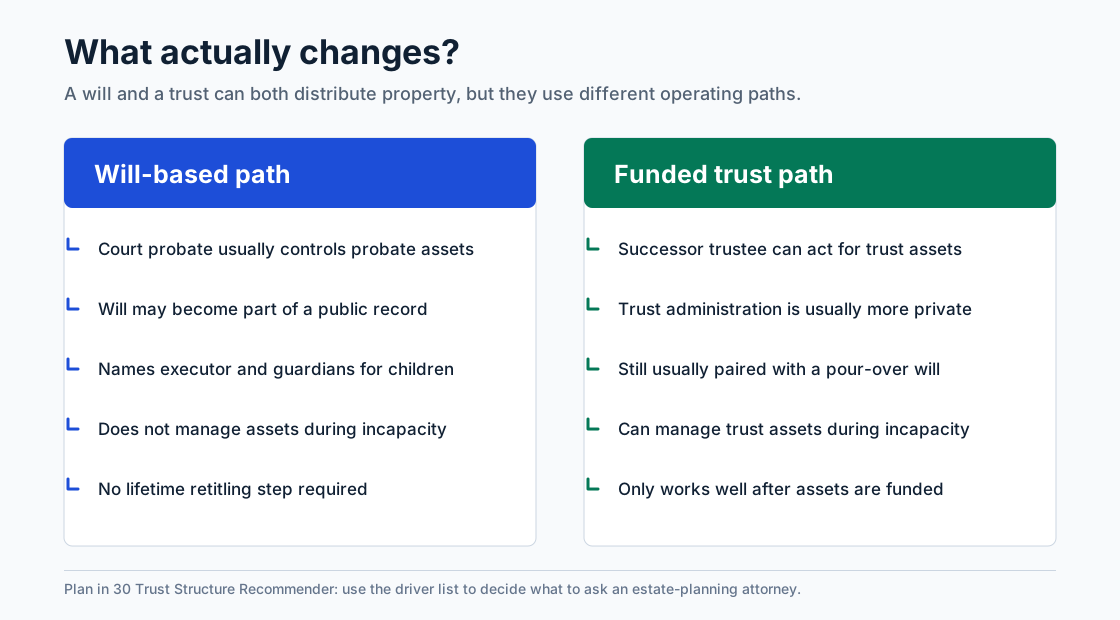
A revocable living trust is not a fancier will. A will and a revocable trust can both say who receives property after death, but they operate through different systems.
The practical difference is this: a will usually waits for probate. A funded revocable living trust can let a successor trustee manage and transfer trust assets without that same probate path.
That difference can matter a lot for privacy, timing, incapacity planning, and real estate in more than one state. It matters much less if the estate is simple, beneficiaries are adults, and most assets already pass by beneficiary designation.
The short answer:
- A will is still foundational. It can name an executor, name guardians for minor children, and catch assets left outside a trust.
- A revocable living trust must be funded to do its job. The trust usually helps only for assets that were retitled to the trust or otherwise directed to it.
- A revocable trust is usually not federal estate-tax planning. Because you can amend or revoke it, the assets are generally still treated as yours.
- The strongest trust reasons are practical: probate avoidance, privacy, incapacity continuity, multi-state property, and controlled distributions.
- The best plan may use both. Many trust-based plans still include a pour-over will and powers of attorney.
Still deciding whether a trust belongs in the plan at all? Start with Do I Need a Trust or Is a Will Enough?, then use this article for the side-by-side revocable-trust comparison.
What a Will Changes
A will is a set of instructions that becomes active at death. It names who handles the estate, who receives probate property, and, for parents, who should serve as guardian for minor children.
That last point is important. A revocable trust can manage money for children, but a will is usually where parents nominate guardians. A trust does not make the will irrelevant.
The tradeoff is that property passing under a will usually goes through probate. Probate can be routine in some states and expensive or slow in others. It can also create public records. The American Bar Association describes a will as the core estate-planning document and separately defines probate as one of the main estate-administration topics families should understand.
State law changes the details. Small-estate procedures, transfer-on-death deeds, probate shortcuts, creditor notices, and trust funding mechanics vary by state, so treat the Trust Advisor result as an attorney-prep checklist rather than a state-specific legal answer.
What a Revocable Living Trust Changes
A revocable living trust is created during life. You can usually amend or revoke it while you are alive. You often serve as the first trustee, then name a successor trustee to step in if you die or become incapacitated.
That changes the mechanics in three ways:
- Assets owned by the trust can often avoid probate.
- A successor trustee can manage trust assets if you become incapacitated.
- The trust document can stay more private than a probated will.
The ABA's revocable trust guidance is careful about the tradeoff: revocable trusts can help avoid probate, but that does not always mean probate avoidance is necessary for every estate. ACTEC makes the same practical point in its probate resources: a revocable trust helps only when assets are properly planned and transferred into the trust during the grantor's lifetime.
The Scenario: Same Couple, Two Different Paths
Consider a married couple in their early 40s:
- Two minor children
- Primary home worth $720,000 with a mortgage
- Taxable brokerage account worth $180,000
- Retirement accounts with beneficiary designations
- $1,500,000 of term life insurance
- No estate tax concern at the federal level
- Privacy and incapacity planning are high priorities
- One spouse's parents live in another state, and the couple may inherit a small vacation property later
This is not an ultra-high-net-worth estate. The question is administration.
Path 1: Will-Based Plan
The couple signs wills, powers of attorney, health care directives, and updates beneficiaries. The wills name guardians for the children and direct assets to the surviving spouse, then to trusts for the children if both parents die.
That can be a good plan. But probate assets still pass through probate. If the home is titled only in one spouse's name at death, the executor may need court authority. If both parents die, the children's inheritance may be handled under trust terms created by the will, but the will still enters probate first.
Path 2: Trust-Based Plan
The couple signs a revocable living trust, retitles the home and brokerage account to the trust, signs a pour-over will, signs powers of attorney and health care directives, and updates beneficiary forms where appropriate.
Now the successor trustee has a clearer path to manage and distribute trust assets. The trust can describe when children receive money, who manages it, and what distributions are allowed for education, health, support, or milestones. The pour-over will catches assets left outside the trust, but the trust-owned home and brokerage account do not depend on the will to move.
The Trust Advisor Experiment
Open the prefilled funded-trust comparison scenario to start with the married couple, minor children, $720,000 home, $180,000 taxable account, life insurance, privacy, incapacity, and multi-state property drivers from the example, then map the drivers to your situation.
The useful output is not "trust wins." It is the driver list.
For this household, the Trust Advisor would likely surface a revocable living trust discussion because several drivers are stacked together:
| Driver | Why it matters |
|---|---|
| Minor children | A plan needs guardianship plus money-management instructions. |
| Home ownership | The home may be a major probate asset if left outside a trust or beneficiary-transfer system. |
| Privacy priority | Trust administration can be less public than probate administration. |
| Incapacity concern | A successor trustee can manage trust assets if the grantor cannot. |
| Distribution control | The couple may not want children receiving assets outright at age 18 or 21. |
| Possible multi-state property | Real estate in another state can create extra probate friction. |
Then remove the privacy concern, remove minor children, and assume all major accounts have clean beneficiary designations. The revocable trust case gets weaker. That is the point of the calculator experiment: the document choice changes when the facts change.
The Funding Step Is the Part People Miss
Signing a trust is not the finish line. A trust that owns nothing may not avoid probate for assets left outside it.
Funding means retitling or directing assets so the trust can actually control them. ACTEC's funding guidance describes this as retitling personal assets so the trust is reflected as owner. For a typical household, that may include:
- Deeding a home into the revocable trust, when appropriate under state law and lender/title rules
- Retitling taxable bank or brokerage accounts
- Coordinating beneficiary designations
- Deciding whether the trust should be primary or contingent beneficiary for certain assets
- Keeping retirement-account tax rules separate from simple trust funding
- Updating the plan after a move, refinance, new account, new child, divorce, or death
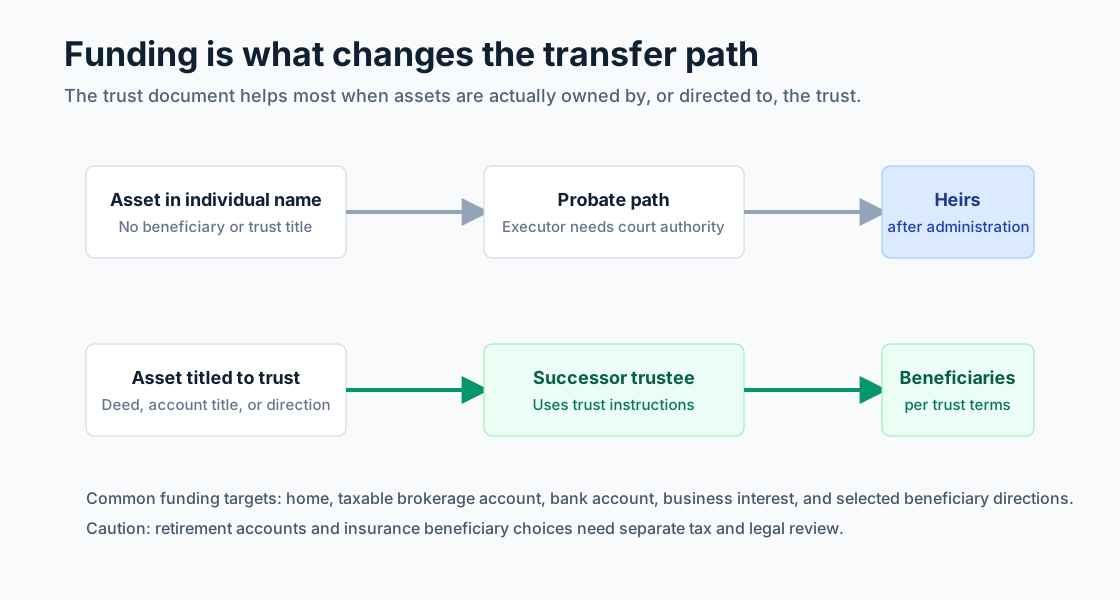
Retirement accounts deserve special caution. Naming a trust as beneficiary can be appropriate in some cases, but it can also create tax and administration issues. Do not treat every asset the same way.
What Does Not Change
A revocable living trust does not solve everything.
It usually does not:
- Replace a guardian nomination for minor children
- Eliminate the need for powers of attorney or health care directives
- Protect your own assets from your own creditors while you are alive
- Remove assets from your federal taxable estate while you retain revocation rights
- Automatically control assets that were never transferred to the trust
- Replace state-specific legal advice
This is why "trust vs will" is the wrong framing for many households. The real choice is "which documents and beneficiary instructions match the risks?"
When a Will-Based Plan May Be Enough
A will-based plan may be a reasonable starting point when:
- The estate is simple.
- Beneficiaries are responsible adults.
- Probate is not especially burdensome in the state.
- Privacy is not a major concern.
- There is no real estate in multiple states.
- Assets mostly pass by beneficiary designation or joint ownership.
- There are no special-needs, blended-family, creditor, tax, or business-owner concerns.
Even then, the will should not stand alone. A basic estate plan usually also needs powers of attorney, health care documents, beneficiary cleanup, executor selection, and clear account records.
When a Revocable Living Trust Deserves a Serious Look
Raise the revocable trust question when several of these are true:
- You own a home and want to reduce probate friction.
- You own real estate in more than one state.
- You want more privacy than probate may provide.
- You want continuity if you become incapacitated.
- You have minor children and want structured money management.
- You have family conflict risk.
- You have a blended family.
- You want a successor trustee to handle assets quickly.
- You are willing to do the funding work after signing documents.
The last item matters. If funding feels unrealistic, a trust may create a false sense of completion. A simpler plan that is fully implemented can beat a sophisticated plan that is never finished.
A Practical Comparison
| Question | Will | Funded revocable living trust |
|---|---|---|
| Takes effect during life? | Usually no | Yes, once created and funded |
| Avoids probate by itself? | Usually no | Often for trust-owned assets |
| Names guardians for minor children? | Yes | Usually no, still use a will |
| Provides incapacity management for owned assets? | No | Yes, through successor trustee terms |
| Private document? | Often becomes public in probate | Usually more private |
| Easy to change while competent? | Usually yes, by updating the will | Usually yes, because it is revocable |
| Requires asset retitling? | No | Yes, if probate avoidance is the goal |
| Federal estate-tax reduction? | Not by itself | Usually not while revocable |
Make the Example Your Own
Start from the article assumptions, then test three versions:
- Your current household and assets.
- The same household with privacy, probate avoidance, and incapacity concerns set high.
- The same household after removing minor children, conflict risk, and multi-state property.
Look for which trust structures move up or down and why. Then bring that driver list to an estate-planning attorney. A useful first meeting is not "please sell me a trust." It is "here are the risks I need the documents to solve."
Save the driver list in four buckets before the meeting: assets already titled to a trust or still outside it, beneficiary-designated assets such as retirement accounts and life insurance, guardianship or distribution-control needs, and property that might create probate in another state.
If the question is which professional belongs in the conversation, the Advisor Recommender can help distinguish an estate-planning attorney, elder-law attorney, CPA, financial planner, and insurance professional. It does not verify or recommend a specific firm.
Bottom Line
A will says what should happen through the estate process. A funded revocable living trust can change who has authority, how private the administration is, and whether some assets need probate at all.
But the trust only helps when the facts call for it and the funding work gets done.
For some households, a will, powers of attorney, health care documents, and beneficiary cleanup are enough for now. For others, a revocable living trust is the cleaner operating system for the home, taxable accounts, incapacity planning, and children's inheritance.
The goal is not to choose the more impressive document. The goal is to make the transfer path clear before anyone has to use it.
Sources
- ABA: Revocable Trusts
- ABA: Estate Planning Information & FAQs
- CFPB: What is a revocable living trust?
- ACTEC: Wills and Trusts - What You Should Know
- ACTEC: Probate - What You Need to Know
- ACTEC: How Does a Revocable Trust Avoid Probate?
- ACTEC: Funding Your Revocable Trust and Other Critical Steps
- FINRA: Choosing Beneficiaries
- IRS: Estate Tax
Educational content only. This is not legal, tax, investment, or financial advice. Estate-planning documents are state-specific and should be reviewed with a qualified attorney.
More Trust Structure Recommender articles
Practical examples that connect the calculator to real planning decisions.