Leasing is usually cheaper if you only compare the monthly payment. It is not automatically cheaper if you compare the full three-year cost.
That difference matters because a lease payment is paying for use of the car. A loan payment is partly interest and partly ownership. The purchase can look more expensive every month but still leave you with trade-in or resale value at the end.
Short answer: leasing can be cheaper over three years when the lease deal is strong, your mileage stays inside the contract, and the purchased car would have weak resale value. Buying can be cheaper when the car holds value, the loan terms are reasonable, and you sell or trade with equity. The only useful answer is the one that includes payment, upfront cash, end fees, mileage, loan balance, and resale value.
What "Cheaper" Means
There are two versions of cheaper:
- Cheaper this month: the option with the lower payment.
- Cheaper over the whole decision period: the option that leaves you spending less after fees, mileage, equity, and resale value.
A lease often wins the first test. That is why leases can feel attractive in a showroom. But the second test is the one that tells you whether the lease actually costs less.
The Consumer Financial Protection Bureau notes that a lease is a contract to use a vehicle for a set period and mileage limit, and you usually do not own the vehicle at the end unless you buy it. The FTC's financing and leasing guide makes the same practical point: leasing and financing have different costs, contract terms, and end-of-term responsibilities.
So the comparison should not be "lease payment versus loan payment." It should be:
Lease cost over the term versus buying cash outflow minus the value you still have.
A 3-Year Scenario
Imagine Priya is choosing between leasing and buying the same $40,000 SUV. She expects to keep the decision simple by comparing the first three years.
| Input | Lease offer | Buy with loan |
|---|---|---|
| Vehicle price | $40,000 | $40,000 |
| Upfront cash | $3,000 due at signing | $3,000 down |
| Term compared | 36 months | First 36 months of a 60-month loan |
| Monthly payment | $475 | $733 |
| End-of-term item | $395 disposition fee | Sell or trade the car |
| Mileage assumption | 12,000 miles/year | 12,000 miles/year |
| Estimated value after 3 years | Contract controls return or buyout | $27,500 base resale estimate |
| Loan balance after 3 years | Not applicable | About $15,900 |
Open the prefilled Priya lease-vs-buy scenario to start with the assumptions above, then map the vehicle price, lease quote, loan terms, resale value, mileage, and upfront cash to your situation.
The lease payment is lower by about $258 per month. Over three years, that is a real cash-flow difference:
- Lease payments: $17,100
- Loan payments: $26,388
If Priya only compares the payment line, leasing looks much cheaper. But the purchase still has a car attached to it.
The Full 3-Year Cost
Here is the same scenario after adding end value.
| Three-year cost item | Lease | Buy, normal resale | Buy, weak resale |
|---|---|---|---|
| Upfront cash | $3,000 | $3,000 | $3,000 |
| Monthly payments | $17,100 | $26,388 | $26,388 |
| Lease-end fee | $395 | $0 | $0 |
| Estimated resale value | $0 | $27,500 | $23,000 |
| Remaining loan balance | $0 | -$15,900 | -$15,900 |
| Estimated equity | $0 | $11,600 | $7,100 |
| Net 3-year cost | $20,495 | $17,788 | $22,288 |
In the normal resale version, buying is cheaper even though the monthly payment is much higher. Priya spends more cash each month, but she may recover about $11,600 of equity when she sells or trades the SUV.
In the weak resale version, leasing is cheaper. The monthly payment advantage is large enough that buying does not catch up when the car is worth less after three years.
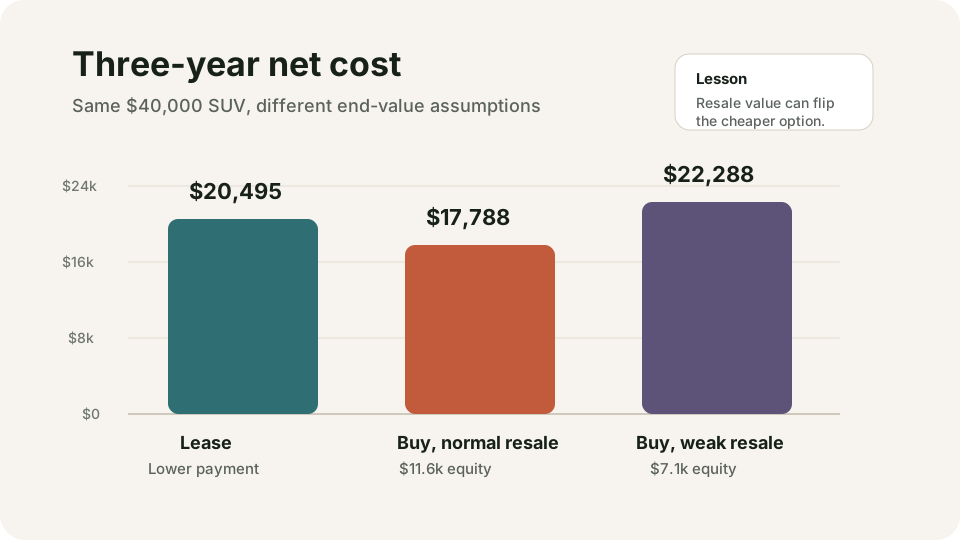
The answer flips when resale value changes. That is why lease-vs-buy math needs both payment and end value.
Why the Answer Can Flip
Lease-vs-buy math is sensitive because several inputs move at once.
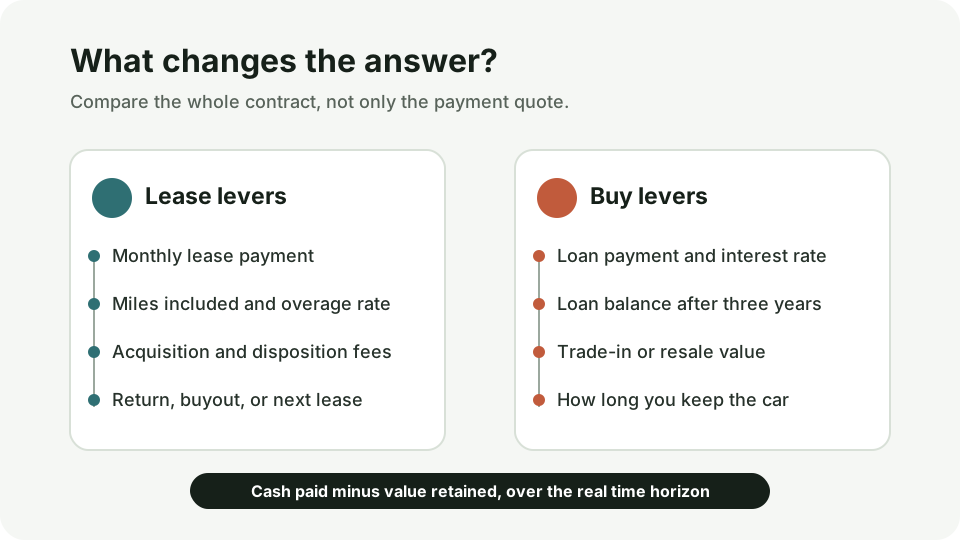
A lease is not just a payment. A purchase is not just ownership. Both sides have assumptions that can move the final cost.
Resale Value
Buying looks better when the car holds value. It looks worse when depreciation is heavier than expected.
In Priya's scenario, changing the three-year resale estimate from $27,500 to $23,000 moves the buying result by $4,500. That single assumption changes the winner.
Mileage
Mileage is one of the biggest lease risks. If Priya signs a 12,000-mile-per-year lease but drives 15,000 miles per year, she is 9,000 miles over the limit after three years. At $0.25 per excess mile, that adds $2,250.
The lease cost becomes:
$20,495 base lease cost + $2,250 mileage charge = $22,745
That would make buying cheaper in the normal resale case and close in the weak resale case.
Upfront Cash
A larger lease down payment can make the monthly payment look better without making the decision safer. If the lease asks for $5,000 due at signing instead of $3,000, the monthly payment may look smaller, but the three-year cost still includes the cash paid upfront.
For a clean comparison, keep upfront cash visible instead of burying it inside the payment.
Loan Rate and Term
Buying becomes harder to justify when the loan has a high rate or a long term that leaves the balance high after three years. A 72- or 84-month loan may lower the payment, but it can also slow equity building and increase interest cost.
That is why the "buy" side should include the loan balance at the comparison date, not just the monthly payment.
When Leasing Is More Likely to Be Cheaper
Leasing is more likely to win the three-year cost test when:
- The lease has strong manufacturer incentives.
- You drive fewer miles than the lease allows.
- You plan to switch cars after three years anyway.
- The car has uncertain or weak resale value.
- You place a high value on lower short-term cash flow.
- You do not want to handle selling or trading the vehicle.
This does not mean leasing is risk-free. The contract still matters. The FTC notes that lease agreements may include mileage limits, wear charges, early termination terms, and other fees. Those details can erase the payment advantage.
When Buying Is More Likely to Be Cheaper
Buying is more likely to win when:
- You keep the car after the comparison period.
- The car holds value better than expected.
- You drive more miles than a lease allows.
- You want flexibility to sell, trade, modify, or keep the vehicle.
- You can afford the higher monthly payment without crowding out other goals.
- You avoid stretching the loan so long that equity builds slowly.
Buying also gives you more paths after three years. You can keep the car, sell it, trade it, refinance, or pay it off faster. That flexibility has value, especially if your mileage or household needs are not predictable.
Common Mistakes
- Calling the lower payment the cheaper car. Lower payment improves cash flow, but it may not lower total cost.
- Ignoring end value. A purchased car can leave equity. A lease return usually does not.
- Forgetting mileage. Extra miles can turn a good lease into an expensive lease.
- Comparing different vehicles. A subsidized lease on one model and a high-rate loan on another is not a clean lease-vs-buy test.
- Treating due at signing as a footnote. The cash due today is part of the cost.
- Assuming resale value is guaranteed. The car may be worth more or less than the estimate.
Make the Example Your Own
Start from Priya's assumptions, then test these versions:
- Lower the resale value to see how quickly buying loses its equity advantage.
- Add excess mileage if your driving could run beyond the lease allowance.
- Increase or reduce upfront cash so the comparison reflects the quote in front of you.
- Change the loan rate or loan term instead of relying on the article's 7% placeholder.
- Extend the ownership period beyond three years if you would probably keep the car longer.
If the winner changes, that is the point. The decision depends less on whether leasing or buying is "always cheaper" and more on whether your driving pattern, cash flow, and exit value match the deal in front of you.
For the broader decision framework, read Lease vs Buy a Car: How to Compare the Real Cost in 2026.
Bottom Line
Leasing can be cheaper than buying, but the lower payment is only the first line of the math. Over three years, the real comparison is lease cash outflow against buying cash outflow minus equity.
Use the lease if the full-term cost is lower and the contract fits your mileage and driving needs. Buy if the equity, flexibility, and longer ownership path are worth the higher payment.
Sources
- Consumer Financial Protection Bureau: Leasing versus buying a car
- Federal Trade Commission: Financing or Leasing a Car
This article is educational and not personalized financial advice. Before signing a lease or loan, compare the written contract terms, fees, mileage limits, taxes, insurance, and your own budget.
More Car Buy vs Lease Calculator articles
Practical examples that connect the calculator to real planning decisions.