The honest answer is not a national average. It is a monthly number tied to your child, your target school type, your current savings, and the share of college you want your family to cover.
For a 6-year-old with $15,000 already saved, a public in-state college target, 5% college-cost inflation, and a moderate 6% return assumption, the difference between saving $450 and $650 a month is the difference between being about 70% funded and almost fully funded in this example.
The short version:
- Start with the future cost, not today's sticker price.
- Subtract what your current 529 balance can grow into.
- Test your monthly contribution against more than one inflation and return assumption.
- Decide whether the goal is full funding or a specific family share.
- Revisit the number every year, because college costs, aid assumptions, and your own cash flow can change.
What "Save Each Month" Really Means
A college savings target has four moving parts:
- Today's annual cost: the cost of the school type you are using as a planning target.
- Years until enrollment: more time gives contributions and investment growth more room to work.
- College-cost inflation: the future bill can be much higher than today's number.
- Family share: the percentage you expect savings to cover after scholarships, grants, student work, or other help.
The monthly amount is the contribution that gets the account close to the future family-share cost. A 529 plan can help because qualified withdrawals are generally tax-advantaged, but the 529 does not remove the planning problem. You still need a contribution that fits the future bill.
If you are deciding whether those monthly dollars belong in a 529 or a taxable account, see 529 Plan vs Taxable Brokerage for College Savings.
College Board's latest Trends in College Pricing materials show why this needs to be a range, not a single average. The report tracks tuition, fees, room, board, net prices, and aid across public two-year, public four-year, and private nonprofit schools. A public in-state plan and a private-school plan are not the same savings problem.
Example Scenario: Avery's College Fund
Let's use one specific child so the math is visible.
| Input | Value |
|---|---|
| Child | Avery, age 6 |
| Starts college | Age 18 |
| School target | Public, in-state |
| Today's annual cost assumption | $28,750 |
| Current 529 balance | $15,000 |
| Investment return assumption | 6% / year |
| College-cost inflation | 5% / year |
| Family share | 100% |
At 5% annual college-cost inflation, a $28,750 annual cost today becomes much larger by the time Avery enrolls. The four college years in this scenario add up to about $222,500 in future dollars.
That number is not a prediction. It is a planning assumption. The value of the calculator is that you can immediately change the annual cost, inflation rate, school type, return assumption, or family-share percentage and see how the monthly target moves.
Open the prefilled Avery college savings scenario to start with the assumptions above, then map the child age, school cost, current balance, monthly contribution, inflation, and return assumptions to your situation.
What the Calculator Shows
Here is the same scenario tested at four monthly contribution levels.
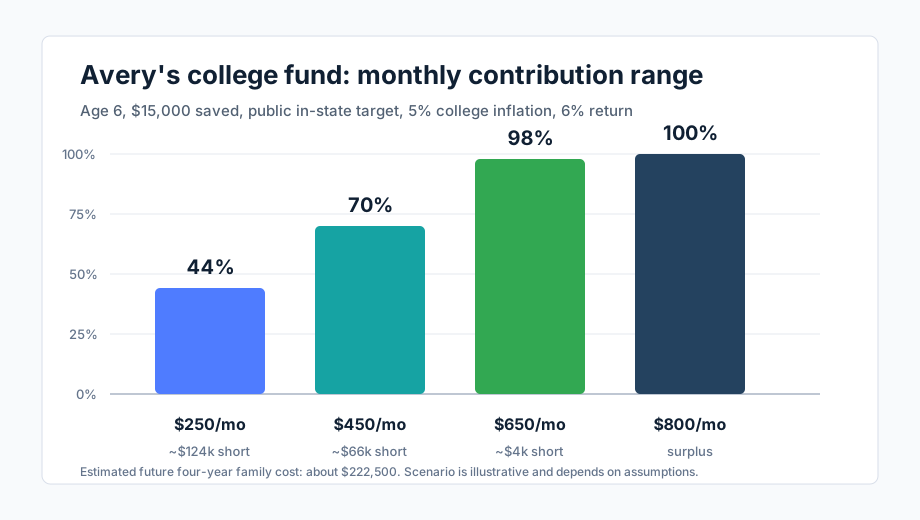
Same child, same school target, same current balance. Only the monthly contribution changes.
| Monthly contribution | Balance near enrollment | Funded share | Estimated shortfall |
|---|---|---|---|
| $250 | ~$82,000 | 44% | ~$124,000 |
| $450 | ~$124,000 | 70% | ~$66,000 |
| $650 | ~$166,000 | 98% | ~$4,000 |
| $800 | ~$197,000 | 100% | $0, with surplus |
The useful insight is not "everyone should save $650." It is that Avery's family now has a concrete range:
- $250/month is meaningful, but it does not fully fund the target.
- $450/month gets most of the way there, but it still leaves a large future gap.
- $650/month nearly closes the gap under these assumptions.
- $800/month may overfund the target if the assumptions hold.
That last point matters. Overfunding is not always a disaster, but it is not free. Some unused 529 money may be redirected to another beneficiary, used for other qualified education expenses, or potentially rolled to the beneficiary's Roth IRA under SECURE 2.0 rules when requirements are met. Those rules have limits, so the better planning move is to watch the surplus before it gets too large; our guide to what happens if you save too much in a 529 walks through the options.
What Changes the Answer
1. Your Current Balance
A head start does two jobs. It reduces what you still need to contribute, and it has time to compound.
In Avery's case, the existing $15,000 balance grows to roughly $30,000 by enrollment before counting any future monthly contributions. A family starting from $0 would need a higher monthly contribution to reach the same funded percentage.
2. Years Until College
The younger the child, the more useful each dollar can be. A toddler has 15 or more years for contributions and growth. A 13-year-old has only about five years before enrollment, so the monthly number has to do much more of the work.
This is why a late-start plan should not copy a newborn plan. The goal may need to shift from "fully fund the whole bill" to "cover a specific share and plan the rest with aid, cash flow, student work, or lower-cost school options."
3. College-Cost Inflation
College inflation is one of the most sensitive assumptions in a long college plan. If you lower the inflation assumption, the future bill falls. If you raise it, the same monthly contribution funds less of the target.
Do not use a high inflation rate to scare yourself or a low one to make the plan look comfortable. Use a reasonable baseline, then run a downside case.
4. School Type
"College" is not one price. The calculator separates public in-state, public out-of-state, private, and custom costs. If you do not know the target school, start with public in-state as a baseline, then test a private or custom target to understand the stretch.
The point is not to promise a child one exact school. It is to understand what each promise would require.
5. Family Share
Many families do not plan to cover 100% of college. That can be a healthy choice, especially if retirement savings, emergency reserves, or debt payoff are not yet stable.
If Avery's family planned to cover 75% instead of 100%, the monthly target would drop materially. In the calculator, this is the family-share setting for each child. It is a simple way to model scholarships, grants, student work, cash-flow support, or a deliberate parent-student split.
Common Mistakes
- Planning from today's cost only. A $28,750 annual cost today is not the same as a $28,750 annual cost 12 years from now.
- Using one average for every child. Multi-child households need per-child timing. The older child has less time for growth.
- Ignoring partial funding. Covering 50% or 75% can be a responsible target if full funding would damage other goals.
- Treating 529 tax benefits as the whole plan. The tax wrapper helps, but contribution amount and time horizon usually do more of the work.
- Forgetting to update the plan. A college plan should be revisited when income changes, the child gets closer to enrollment, or the target school type changes.
Make the Example Your Own
Start from Avery's baseline:
- One child, age 6
- Public in-state target
- $15,000 current balance
- $450 monthly contribution
- 5% college-cost inflation
- 6% investment return
Then test three versions:
- Raise the monthly contribution to $650 and watch the shortfall nearly disappear.
- Change the school type to private and see how much the target expands.
- Lower the family share to 75% if full funding is not the right household goal.
Compare funded percentage, shortfall, and surplus before deciding the monthly amount is right.
Related: 529 Plan vs Taxable Brokerage for College Savings and What If You Save Too Much in a 529?.
Sources and Notes
- College Board Trends in College Pricing
- College Board Trends in College Pricing and Student Aid 2025 full report
- IRS Topic No. 313, Qualified Tuition Programs
- IRS Publication 970, Tax Benefits for Education
- IRS gift tax FAQ
- Federal Student Aid 2026-27 FAFSA form
This article is educational planning content, not personalized financial, tax, investment, or college financial-aid advice. A 529 plan's state tax treatment, qualified expenses, contribution rules, and financial-aid impact can depend on your state, account ownership, beneficiary, and current law.
More 529 College Savings Calculator articles
Practical examples that connect the calculator to real planning decisions.
529 Plan vs Taxable Brokerage for College Savings
Compare a 529 plan vs a taxable brokerage for college savings with a concrete 12-year scenario, tax drag, flexibility tradeoffs, and 529 overfunding risks.
What If You Save Too Much in a 529?
Saving too much in a 529 is usually manageable, but it is still worth planning. See the options for unused 529 money and a concrete surplus scenario.