The hard part of a group trip is not the average cost. It is that nobody is actually average.
One friend flies from a cheaper airport. One wants the concert ticket. One can share a room but not a rental car. One person pays the lodging deposit today and waits three months for everyone else to catch up. A useful group trip budget has to separate shared costs from individual costs before the trip becomes a reimbursement argument.
For a realistic five-night domestic city trip with four friends, a good starting estimate is about $1,660 per person before optional upgrades. In the example below, the two friends who add a concert ticket land closer to $1,800. The right number for your trip can be higher or lower, but the method is the same: price the fixed travel pieces, split only the shared costs, give optional items to the people who opt in, and add a visible buffer.
A useful planning pass separates the shared costs, individual costs, optional choices, and payment timing before anyone books the expensive piece.
What A Group Trip Budget Needs To Include
A group trip budget should answer five questions:
- What does each traveler pay individually?
- Which costs are shared equally?
- Which costs are optional?
- When does cash leave someone's account?
- How much should each person save before the trip?
That means the budget needs more than one total number. It needs categories that behave differently:
| Category | Usually split how? | Why it matters |
|---|---|---|
| Flights or trains | Per traveler | People may leave from different cities or book different fare classes. |
| Lodging | Shared by room, bed, or party | One person often fronts the deposit. Taxes and fees can change the true nightly cost. |
| Ground transportation | Shared or usage-based | Airport transfers, rental cars, fuel, parking, and rideshares are easy to undercount. |
| Meals | Per traveler or pooled | A meal allowance works better than guessing every restaurant. |
| Activities | Opt-in or shared | Optional upgrades should not be forced on the whole group. |
| Buffer | Shared by default | A visible cushion prevents one surprise expense from becoming a social problem. |
The sample numbers below are planning assumptions. The public sources are category checks, not a claim that every traveler will see those exact prices.
Government travel benchmarks can help sanity-check the meal and lodging parts of the estimate. GSA per diem rates are designed for federal travel, not vacations, but they show that lodging and meals vary by city and date; for fiscal year 2026 the standard continental U.S. lodging rate is $110 and the standard meals and incidental expenses rate is $68, with higher rates in many locations. Domestic airfare data also varies by market; BTS says its average-fare reports are based on itinerary fares that include airline charges plus taxes and outside fees collected at purchase.
Those are benchmarks, not your final budget. A personal trip still needs your actual flights, stay, itinerary, and comfort level.
Example Scenario: Four Friends, Five Nights
Here is a concrete group trip plan:
| Input | Scenario |
|---|---|
| Travelers | 4 friends |
| Trip length | 5 nights, 6 calendar days |
| Destination | Domestic city trip |
| Planning window | 8 months until departure |
| Lodging | Shared two-bedroom stay |
| Transportation | Each person books their own flight; group shares local rides |
| Activities | One shared activity and one optional concert |
| Goal | Know each person's savings target before booking |
The first pass looks like this:
| Budget line | Group total | Split method |
|---|---|---|
| Flights from four origin cities | $1,560 | Individual |
| Lodging, taxes, and fees | $1,950 | Split four ways |
| Airport transfers and local rides | $420 | Split four ways |
| Meals and snacks | $1,800 | Individual allowance |
| Shared activity | $440 | Split four ways |
| 10% buffer on controllable trip costs | $461 | Split four ways |
| Optional concert for two travelers | $280 | Opt-in only |
The group cost before optional upgrades is $6,631, or about $1,658 per traveler on average. But the traveler-level totals are not identical:
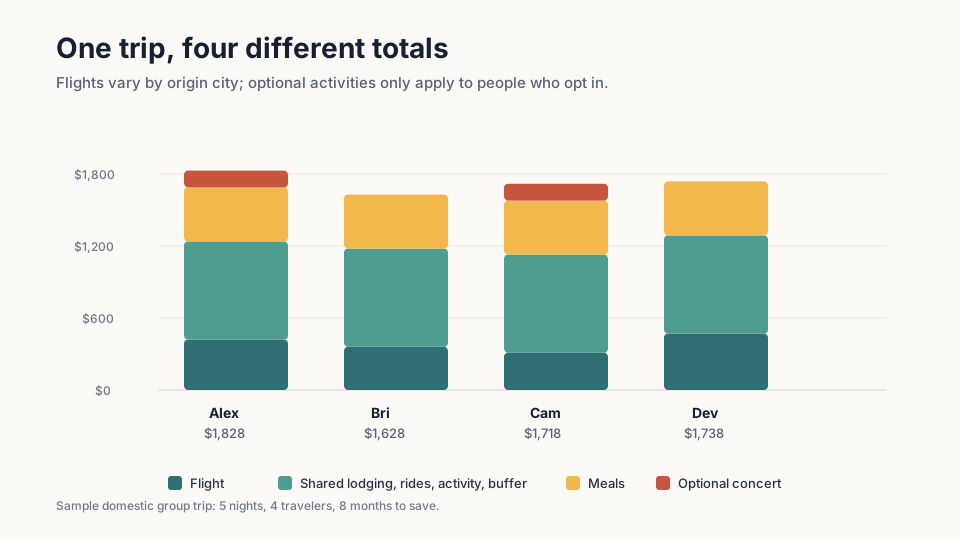
| Traveler | Flight | Shared lodging, rides, activity, buffer | Meals | Optional concert | Estimated total | Monthly savings over 8 months |
|---|---|---|---|---|---|---|
| Alex | $420 | $818 | $450 | $140 | $1,828 | $229 |
| Bri | $360 | $818 | $450 | $0 | $1,628 | $204 |
| Cam | $310 | $818 | $450 | $140 | $1,718 | $215 |
| Dev | $470 | $818 | $450 | $0 | $1,738 | $217 |
This is why a single average can mislead the group. The average tells you the trip is around $1,700 per person. The split tells Alex to save $229 per month, Bri to save $204, Cam to save $215, and Dev to save $217.
Cash timing can still be uneven even when the final split is fair:
| Timing item | Who fronts it first? | What the group should record |
|---|---|---|
| Lodging deposit today | One traveler | Deposit amount, reimbursement due date, and each person's share |
| Shared activity in month 2 | Whoever books | Whether it is all-group or opt-in |
| Remaining lodging and food before departure | Each traveler plus the lodging booker | Final balance deadline and any cash still owed |
That table keeps the reimbursement problem separate from the final per-person total. Alex and Bri can owe similar trip totals while one of them still needs more cash today.
Open the prefilled four-friend group trip budget to start with the flights, lodging, local rides, meals, shared activity, optional concert, and buffer from the example, then map the plan to your group.
The Mistake: Splitting Everything Equally
If the group simply divides the full $6,911 including optional concert tickets by four, everyone pays about $1,728.
That sounds simple, but it creates two problems:
- Bri and Dev would subsidize an event they are not attending.
- Cam, who has the cheapest flight but chose the concert, would be treated the same as Dev, who has the most expensive flight and skipped the concert.
Equal splits work for truly shared costs. They do not work for individual transportation or optional choices. A fair budget does not have to be complicated, but it has to match the way the cost is created.
For a deeper split-method walkthrough, see How to Split Vacation Costs Without Making It Awkward.
Build The Budget In The Right Order
1. Start With Individual Transportation
Put flights, trains, checked bags, parking, and airport transfers in the budget before debating restaurants or activities. Transportation is often the largest reason one traveler's total differs from another's.
For the sample trip, flights range from $310 to $470. That $160 spread is enough to change each person's monthly savings target.
2. Price Lodging With Taxes And Fees
Do not budget only the nightly headline rate. Add lodging taxes, platform fees, resort fees, cleaning fees, parking, and any refundable deposit that still has to be fronted.
For this scenario, the group estimates lodging at $1,950 all-in. Split evenly, that is $487.50 per traveler.
If one person gets a private room while others share, equal splitting may not feel fair. In that case, split lodging by room, bed, or agreed comfort level instead of forcing a clean four-way split.
3. Use A Meal Allowance Instead Of Guessing Every Meal
Food is where vacation budgets quietly drift. A practical first estimate is a daily meal allowance:
$75 per person per day x 6 days = $450 per travelerThat number is not a rule. It is a starting point. Lower it if breakfast is included, the group will buy groceries, or the destination is cheaper. Raise it if the itinerary has restaurant reservations, drinks, or a high-cost city.
The important part is making the assumption visible. "Meals: $450 each" is easier to discuss than "we will figure food out later."
4. Separate Shared Activities From Optional Activities
In the example, everyone joins the $110 shared activity. Only Alex and Cam choose the $140 concert.
That creates two lines:
| Activity | Who pays? | Budget treatment |
|---|---|---|
| Shared tour or event | All four travelers | Split equally |
| Concert upgrade | Alex and Cam only | Assign only to opt-in travelers |
This is the difference between a budget and a negotiation. The group can still choose the same itinerary, but nobody has to pretend every choice belongs to everyone.
5. Add A Visible Buffer
A 10% buffer on controllable trip costs adds $461 to this plan, or about $115 per traveler. That cushion can cover a rideshare surge, price movement before booking, extra snacks, tips, baggage fees, or one activity that costs more than expected.
The buffer should be visible, not hidden inside every line. When the trip ends under budget, the group can decide whether to refund it, roll it into a final meal, or leave it unused.
What Changes The Answer?
The Destination
A city with higher lodging, meals, local taxes, and airport-transfer costs can change the budget even if the flights look cheap. A cheaper destination with expensive flights can do the opposite.
The Booking Window
The trip total is only half the planning problem. The other half is timing. A $1,700 trip eight months away needs roughly $213 per month. The same trip three months away needs about $567 per month.
The Group Size
More travelers can reduce shared lodging and transportation costs per person, but only if the group can still use the same rental, room block, or vehicle. Once a bigger group requires a second car, extra room, or larger house, the savings can flatten.
Optional Upgrades
Optional items are not bad. They are often what makes the trip fun. The issue is whether they are priced as optional. Concerts, spa days, guided tours, premium seats, golf, boat rentals, and upgraded rooms should be assigned to the travelers who choose them.
Passport, Visa, And Document Costs
For international trips, add document costs before calling the budget done. The State Department's passport fee page lists a $130 adult passport book application fee and a separate $35 acceptance fee for first-time adult applicants using Form DS-11. Expedited service adds more. Those costs may not apply to everyone, but when they do, they can matter as much as an activity.
Make the Example Your Own
Start from the article assumptions, then test three versions:
- Replace the sample flights, lodging, rides, meals, activities, and booking dates with the actual quotes your group has.
- Move the optional concert in or out of the plan and see which travelers' targets change.
- Change the trip from eight months away to four months away, then compare the monthly savings target.
The goal is not to predict every dollar perfectly. The goal is to make the tradeoffs visible before anyone books the expensive piece.
Bottom Line
A useful group trip budget is not one total divided by the number of travelers. It is a map of which costs belong to the group, which costs belong to each person, and which upgrades are optional.
For the sample trip, the planning answer is about $1,660 per person before optional upgrades, with traveler-specific savings targets from about $204 to $229 per month over eight months. That range is the point. Once each person can see their own number, the group can make better decisions about lodging, activities, timing, and what to book first.
This article is educational and uses a simplified sample scenario. It is not personalized financial, tax, legal, or travel advice. Actual travel prices, taxes, fees, refund rules, and document requirements vary by date, destination, vendor, and traveler.
Sources
More Group Trip Planner articles
Practical examples that connect the calculator to real planning decisions.