Short Answer
You are on track for retirement when your current balance and planned future contributions can reasonably grow into the target you need by your retirement date. A single balance benchmark can be useful, but it can also mislead you. The better question is:
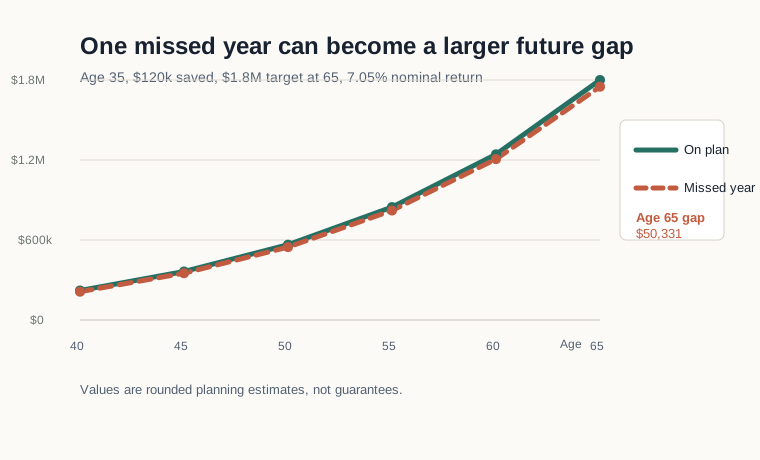
If I keep saving from here, does my projected path still reach the target?For example, suppose a 35-year-old has $120,000 saved, wants $1.8 million by age 65, and plans around the Retirement Saver default 7.05% nominal blended return. Under those assumptions, the plan needs about $764/month. If that saver skips the fifth year of contributions and then checks in at age 40, the visible gap is only about $9,166. Left unrepaired, that missed year compounds into about $50,331 less by age 65.
That is why an on-track check should treat retirement as a path. The useful output is not just today's balance. It is the contribution required from today forward.
Why Balance Benchmarks Feel So Confusing
Retirement advice often talks about having a certain multiple of salary saved by a certain age. Those rules can be a helpful starting point, but they leave out the inputs that decide your actual plan:
- Your current age and target retirement age.
- Your current retirement balance.
- The target nest egg you are planning toward.
- The return assumption you are willing to use.
- How much future contributions can grow.
- Whether employer contributions, IRA savings, brokerage savings, or HSA balances are part of the plan.
A 35-year-old with $120,000 saved can be ahead, behind, or roughly on track depending on the target. The same balance means something different for a $900,000 target than it does for a $2.5 million target.
Read the Gap as a Projection, Not a Grade
A retirement gap is not a moral score. It is the difference between the balance your current plan is projected to produce and the balance you want at the target age.
In the example above, the age-35 plan works like this:
- Current balance: $120,000
- Target balance: $1.8 million
- Time horizon: 30 years
- Planning return: 7.05% nominal
- Required contribution: about $9,166 per year, or $764/month
Without any new contributions, the current $120,000 would project to about $926,363 by age 65 under the same return assumption. The contribution plan is what bridges the remaining distance.
Open the prefilled retirement savings gap check to start with the assumptions above, then map the age, current balance, target age, target nest egg, return, and contribution-growth assumptions to your situation.
The Department of Labor retirement planning materials emphasize turning retirement into worksheets, income needs, savings rates, and concrete action steps instead of vague guessing. The Consumer Financial Protection Bureau also explains why compound interest makes time an important part of the result: money can earn returns on prior returns, not only on the original amount.
What Happens When You Fall Behind
Assume the saver contributes the planned amount for four years, skips year five, and checks the plan at age 40.
| Age 40 checkpoint | Projected balance |
|---|---|
| On-plan path | $221,463 |
| After one skipped contribution year | $212,297 |
| Visible age-40 gap | $9,166 |
The age-40 gap looks manageable because it is close to one annual contribution. But the missed contribution also loses 25 more years of potential compounding. If the saver does nothing, the projected age-65 balance falls to about $1,749,669, roughly $50,331 short of the original target.
That does not mean the plan failed. It means the next checkpoint should update the required contribution. Starting at age 40 with the lower balance, the plan now needs about $830/month instead of $764/month.
Four Ways to Close a Retirement Savings Gap
Once you know the size of the gap, the levers are straightforward.
1. Increase the monthly contribution
This is the cleanest fix when the gap is small. In the example, increasing the contribution from about $764/month to about $830/month puts the plan back on the same $1.8 million target after the missed year.
If you use a workplace plan, remember that tax limits can cap how much can go into each account type. The IRS 2026 limit announcement and IRS retirement contribution topic page list current contribution limits and catch-up rules. If a required contribution is higher than one account can accept, you may need to combine account buckets or adjust the target.
2. Let contributions grow with income
Some savers cannot jump immediately to the full monthly number. A contribution-growth plan can start lower and rise after raises, bonuses, debt payoff, or childcare costs ease. This works best when the increases are scheduled, not left as a vague intention.
3. Extend the timeline
A later retirement age gives the balance more time to compound and gives you more contribution years. This can materially reduce the required monthly amount, but it should be treated as a planning lever, not a guarantee. Health, job availability, caregiving, and preference can all change the actual retirement date.
4. Revisit the target
Sometimes the target itself is the assumption that needs work. A retirement-income calculator can help translate future spending, Social Security, withdrawals, taxes, and healthcare assumptions into a nest egg target. The Retirement Saver is best for the accumulation question: how much to contribute from here to reach a chosen target.
A Simple Check-In Routine
Use a repeatable retirement check-in instead of waiting for a crisis.
- Update your current balance across the accounts you want included.
- Keep the same target and retirement age unless something meaningful changed.
- Compare the new required contribution with the old one.
- If the contribution increased, identify why: lower balance, missed savings, lower return assumption, shorter timeline, or higher target.
- Choose one adjustment for the next year.
This keeps the conversation practical. Instead of asking, "Am I good or bad at retirement?" you are asking, "What monthly contribution keeps this target alive from here?"
Make the Example Your Own
Start from the article assumptions, then map them to your situation:
- Replace the age, current balance, target age, and target nest egg.
- Update the return assumption and contribution growth to match your planning view.
- Re-run the missed-year check to see whether the gap is a one-year catch-up or a bigger adjustment.
Compare the required monthly contribution, projected balance, and age-40 gap before changing the target. The point of an on-track check is not to make the future certain. It is to make the next adjustment visible.
Related: How Much Should I Save for Retirement Each Month?.
Sources
- IRS: 401(k) limit increases to $24,500 for 2026, IRA limit increases to $7,500
- IRS: Retirement topics - contributions
- U.S. Department of Labor: Retirement Savings Toolkit
- Consumer Financial Protection Bureau: How does compound interest work?
- Investor.gov: Compound Interest Calculator
This article is educational and not personalized financial, tax, legal, retirement, or investment advice.
More Retirement Saver articles
Practical examples that connect the calculator to real planning decisions.