Short Answer
Guest count is one of the fastest ways to change a wedding budget, but the math is not as simple as multiplying every guest by an average cost.
If you are still setting the overall target first, start with How Much Should You Budget for a Wedding in 2026?, then come back here to pressure-test the guest list.
Some costs move almost directly with headcount: dinner, bar, rentals, cake, stationery, favors, vendor meals, shuttles, and sometimes staffing. Other costs are mostly fixed once you choose the wedding style: photography, DJ, attire, officiant, website, planning tools, and much of the decor. Venue costs sit in the middle because a 150-person wedding may require a larger room, higher food minimum, extra staffing, or different rental package.
That is why a 50-guest wedding is usually not half the cost of a 100-guest wedding, and a 150-guest wedding is not automatically three times a 50-guest wedding. The right question is: which lines are fixed, which lines are per guest, and which lines jump when the event gets larger?
A useful planning pass builds three versions of the same wedding before you sign a venue contract. Keep the style, city, date, photographer, entertainment, attire, and flowers mostly the same. Then change the guest count and update the lines that actually depend on it.
What Guest Count Really Means
Guest count is not just the number of invitations you send. For budget planning, it is the number of people you expect to host, feed, seat, serve, transport, and include in the day.
In current wedding cost reporting, The Knot's 2026 Real Weddings Study describes an average 2025 U.S. wedding cost around $34,200, with an average guest count of 117 and an average cost per guest of $292. NerdWallet's recent wedding cost guide also places the average 2025 wedding around the mid-$30,000 range. Those figures are useful context, but they are not a quote for your wedding.
Averages blend fixed and variable costs together. If your photographer costs $4,800, that line does not become $2,400 because you invited 50 people instead of 100. But if food and bar are $145 per person, removing 20 guests changes that line by $2,900 before rentals, cake, stationery, favors, and tips.
Example Scenario: Same Wedding, Three Guest Lists
Here is a planning scenario for Jordan and Priya:
- Wedding date: October 2027
- Location: mid-cost U.S. metro
- Style: ceremony and reception at one venue
- Priorities: good food, strong photography, simple flowers, DJ instead of live band
- Planning question: should they invite close family and friends only, the full local circle, or a larger extended-family list?
They compare three guest counts:
| Plan | Guests | Best description |
|---|---|---|
| Smaller wedding | 50 | Close family, wedding party, and closest friends |
| Standard wedding | 100 | Family, friends, local relatives, and a few work friends |
| Larger wedding | 150 | Extended family, more plus-ones, and a broader friend group |
For the experiment, they keep the wedding style mostly the same. The photographer, DJ, attire, base flowers, officiant, and planning costs do not change much. Food, bar, rentals, cake, stationery, favors, transportation, and some staffing do change.
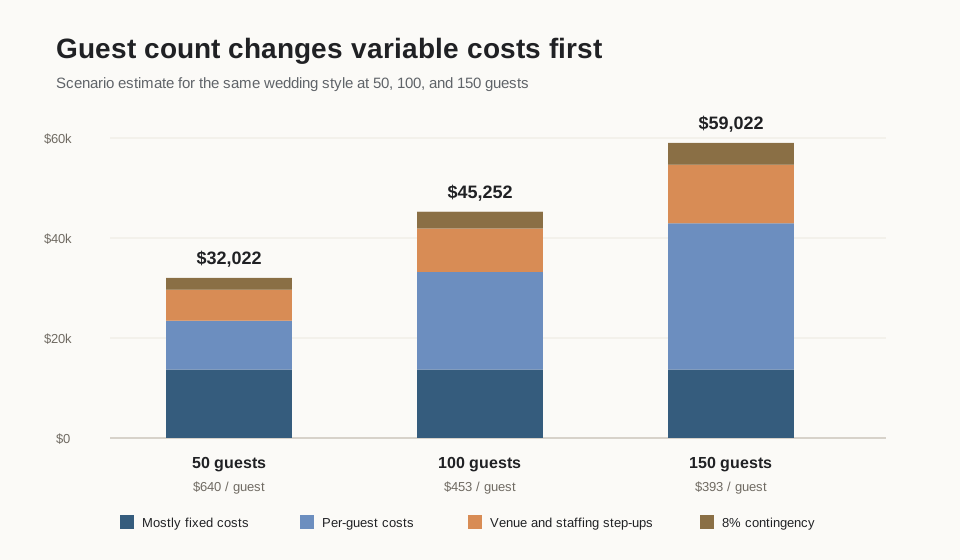
| Cost group | 50 guests | 100 guests | 150 guests | What changes |
|---|---|---|---|---|
| Mostly fixed costs | $13,700 | $13,700 | $13,700 | Photo/video, DJ, attire, beauty, base decor, officiant |
| Per-guest costs | $9,750 | $19,500 | $29,250 | Food, bar, rentals, cake, favors, stationery, transport |
| Venue and staffing step-ups | $6,200 | $8,700 | $11,700 | Room size, service staff, setup, security, rental scope |
| 8% contingency | $2,372 | $3,352 | $4,372 | Buffer grows with the subtotal |
| Estimated total | $32,022 | $45,252 | $59,022 | Guest count changes the budget, but not evenly |
The 50-person version is cheaper, but it still costs about $32,000 because many vendors and wedding-day basics are already in the plan. The 150-person version adds about $13,800 compared with the 100-person version, because each additional guest affects several lines and pushes the venue/staffing package higher.
Open the prefilled 100-guest wedding budget to start with the fixed, per-guest, venue step-up, and contingency lines from the 100-guest version, then map the levers to your guest list.
The Fixed-Cost Trap
Small weddings can surprise couples because fixed costs do not shrink gracefully.
If you want a professional photographer, a DJ, wedding attire, ceremony setup, flowers, hair and makeup, a venue, and a planned reception, many of those costs exist whether the room has 50 people or 100. The fixed-cost share is why a smaller wedding can have a higher cost per guest even when the total is lower.
In the example above:
| Plan | Total | Cost per guest | Why it looks high or low |
|---|---|---|---|
| 50 guests | $32,022 | $640 | Fixed costs are spread over fewer people |
| 100 guests | $45,252 | $453 | Fixed costs are spread over more people |
| 150 guests | $59,022 | $393 | More variable costs, but the fixed base is diluted |
This does not mean a larger wedding is better value. It means cost per guest can be misleading. If your goal is to keep total spending under control, the total cash required matters more than making the per-guest number look efficient.
The Variable-Cost Lever
Guest count becomes powerful when you isolate the costs that truly move with each person.
In Jordan and Priya's example, the per-guest bundle is roughly $195:
- $145 for food and bar
- $18 for rentals and tabletop items
- $8 for cake and dessert
- $14 for stationery, favors, and postage
- $10 for transportation and logistics
That means every 10 guests changes the plan by about $1,950 before any venue minimums, service charges, tax, gratuity, or contingency. Cutting 20 guests from the 150-person version could save close to $3,900 in direct per-guest costs, plus some buffer and possibly a staffing or room-size step-up.
This is why guest list work often beats small line-item cuts. Removing a small decor upgrade may save $300. Moving from 150 guests to 130 may change food, bar, rentals, cake, favors, transportation, staffing, and contingency at the same time.
Venue Capacity Can Create Step Costs
The hardest part of guest-count budgeting is that some costs are not fully fixed or fully variable.
A venue may quote:
- A room fee that changes by space.
- A food and beverage minimum that rises with the larger room.
- Extra bartenders after a certain guest count.
- More security, valet, restroom trailers, shuttle capacity, or cleanup staff.
- A larger dance floor, more tables, more linens, and more tabletop rentals.
That creates step costs. The 101st guest might not just add one meal. It might move you into a larger package.
Use a venue quote worksheet so the jump is visible before the deposit:
| Quote version | Room or package | Food and beverage minimum | Staffing, security, and rentals | Fully loaded quote |
|---|---|---|---|---|
| 118 guests | Garden room | $15,000 | Standard team; linens included | $29,600 |
| 126 guests | Ballroom package | $20,000 | Extra bartender, security, and larger dance floor | $35,900 |
In that example, eight extra guests trigger about $6,300 of additional quote cost. The meal count matters, but the larger room, minimum, and staffing package do more damage than the eight plates by themselves.
Before you pay a deposit, ask venues for quotes at two or three guest counts. For example, request 80, 100, and 120 guests if you are unsure where the list will land. Put each quote into the planner as separate line items instead of keeping one blended venue number.
Make the Example Your Own
Start from the article assumptions, then test three versions:
- A smaller version with 15 to 25 fewer guests.
- The current likely version.
- A higher-RSVP version with 10% more guests than expected.
For each version, update food, bar, rentals, cake, stationery, favors, transportation, staffing, and contingency. If the larger list changes the room or food minimum, update that too.
The goal is not to find the cheapest possible wedding. It is to see the tradeoff before the guest list becomes emotionally locked.
Questions to Ask Before Finalizing the Guest List
Use these questions before sending save-the-dates:
- Which guests are must-invite people, and which are nice-to-invite people?
- Does the venue quote change at 75, 100, 125, or 150 guests?
- What is the fully loaded per-person cost after food, bar, tax, service charges, rentals, and tips?
- Does each added table create floral, linen, rental, and staffing costs?
- How many guests are likely to travel, need transportation, or require hotel blocks?
- Are plus-ones and children included in the current count?
- What happens if the final RSVP count is 10% higher than expected?
A guest list is a budget document. Treat it like one before the venue deposit makes the decision harder to unwind.
Common Mistakes
- Using one national cost-per-guest average as if it applies to every vendor line.
- Forgetting that fixed costs make small weddings look expensive per person.
- Assuming a larger wedding grows smoothly instead of checking venue package step-ups.
- Cutting small details before testing a smaller guest list.
- Comparing two venues without asking how the quote changes at different headcounts.
- Leaving no contingency for service charges, tax, tips, overtime, or rental additions.
What To Do With The Three Totals
When the three totals are visible side by side, the guest-list conversation becomes more concrete. You are no longer debating whether people matter. You are deciding which version of the day fits the money, timing, and priorities you actually have.
Sources and Notes
- The Knot average wedding cost and Real Weddings data
- The Knot 2026 Real Weddings Study data readout
- NerdWallet guide to average wedding cost
- NerdWallet guide to creating a wedding budget
This article is educational planning content, not personalized financial, legal, or tax advice. Vendor pricing, service charges, minimums, taxes, gratuities, and contract terms vary by location and vendor.
More Wedding Budget Calculator articles
Practical examples that connect the calculator to real planning decisions.