Short Answer
A rental property breaks even on monthly cash flow when collected rent covers vacancy, management, mortgage payments, and operating expenses. In the example below, a $450,000 rental with a 20% down payment and a 7% mortgage needs about $3,950 of monthly rent just to reach first-year cash-flow break-even.
That does not mean $3,950 is automatically a good deal. It means the property is no longer asking the owner to add cash each month before taxes, repairs above the estimate, capital replacements, or the opportunity cost of the down payment. A better investment test asks two questions:
- What rent keeps monthly cash flow near zero or better?
- After tying up the down payment and closing costs, does the property beat the next best use of that cash?
The useful workflow is to change rent, vacancy, management, mortgage rate, expenses, holding period, appreciation, and stock-return assumptions one at a time instead of trusting a single rent estimate.
What Break-Even Rent Means
Break-even rent is the monthly rent target where the property stops losing cash before income taxes. It is a cash-flow test, not a total-return test.
A simple version looks like this:
break-even rent = monthly mortgage and operating costs / rent collection rateThe rent collection rate is gross rent after vacancy and management fees. If vacancy is 5% and management is 8% of collected rent, each dollar of advertised rent turns into about 87.4 cents before the mortgage and other expenses:
$1.00 x 95% x 92% = $0.874That small adjustment matters. A $4,000 rent listing does not produce $4,000 of usable rent if the unit is vacant part of the year or if a manager collects a percentage of rent.
The Example Property
Here is the screening scenario for this article:
| Input | Scenario |
|---|---|
| Purchase price | $450,000 |
| Down payment | 20%, or $90,000 |
| Buyer closing costs | 3%, or $13,500 |
| Initial cash invested | $103,500 |
| Mortgage | $360,000 at 7% for 30 years |
| Monthly principal and interest | About $2,395 |
| Vacancy assumption | 5% |
| Property management | 8% of collected rent |
| Operating expenses | $1,050 per month |
| Appreciation assumption | 3% per year |
| Selling costs | 6% at sale |
| Holding period | 10 years |
| Stocks-side alternative | 7% per year |
The $1,050 operating-expense line is a sample allowance for property taxes, insurance, maintenance, repairs, reserves, HOA dues, owner-paid utilities, and other recurring costs. It should be replaced with local numbers before making an offer.
Rental tax rules are separate from this first cash-flow screen. The IRS explains rental income, ordinary expenses, depreciation, and related rules in Topic No. 414 and Publication 527. This article is an educational model, not tax advice.
Open the prefilled $450,000 break-even rent scenario to start with the price, financing, vacancy, management, expense, and break-even rent assumptions above, then map the deal to your situation.
Step 1: Convert Rent Into Collected Rent
Start with a rent estimate, then reduce it for vacancy and management.
| Gross monthly rent | After 5% vacancy | After 8% management fee |
|---|---|---|
| $2,800 | $2,660 | $2,447 |
| $3,200 | $3,040 | $2,797 |
| $3,600 | $3,420 | $3,146 |
| $4,000 | $3,800 | $3,496 |
| $4,300 | $4,085 | $3,758 |
Vacancy should be explicit because a full-rent month and a collected-rent year are not the same thing. The U.S. Census Bureau publishes Housing Vacancies and Homeownership data as a national data source, but local vacancy and turnover can be very different from national averages.
Step 2: Add The Monthly Cost Stack
For this property, the fixed monthly cost stack is about:
| Cost | Monthly amount |
|---|---|
| Mortgage principal and interest | $2,395 |
| Operating expenses | $1,050 |
| Total before vacancy and management | $3,445 |
The break-even rent is not $3,445 because the property does not keep every rent dollar. With the 87.4% collection rate from vacancy and management:
$3,445 / 0.874 = about $3,942Rounded for real-world screening, this property needs about $3,950 per month to break even in year one.
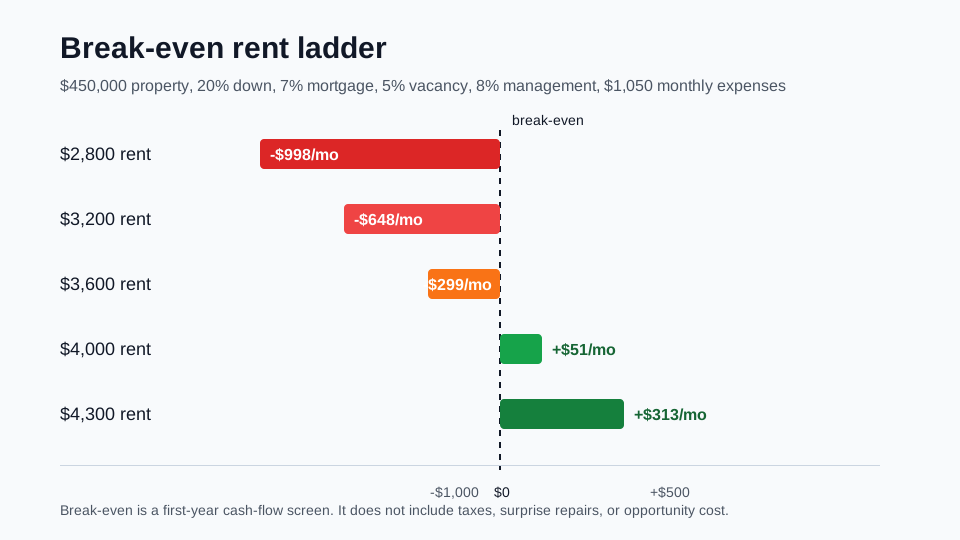
Step 3: Test A Rent Ladder
Using the same property, mortgage, vacancy, management, and expense assumptions:
| Monthly rent | Estimated year-one cash flow | What it means |
|---|---|---|
| $2,800 | -$998/month | The rent is far below break-even. The owner must fund a large shortfall. |
| $3,200 | -$648/month | Still meaningfully negative before taxes and surprise repairs. |
| $3,600 | -$299/month | Closer, but the property still needs owner cash each month. |
| $4,000 | +$51/month | Near break-even. Small changes can flip it negative. |
| $4,300 | +$313/month | More cushion, but still needs a total-return test. |
This is the practical lesson: a property can be close to break-even and still fragile. If insurance rises, a repair reserve is too low, the rate quote changes, or the unit sits empty longer than expected, a small positive number can disappear.
Break-Even Is Not The Same As A Good Investment
First-year cash-flow break-even answers a narrow question: "Do I expect to add cash each month?"
It does not answer:
- Is the purchase price attractive?
- Is the neighborhood likely to support the rent assumption?
- Are repairs and capital replacements realistic?
- How much could the same $103,500 earn elsewhere?
- What happens if appreciation is lower than expected?
- What happens if I sell sooner than planned?
In this example, the investor ties up about $103,500 at purchase. If that same cash compounded at 7% for 10 years, it would grow to about $204,000 before taxes and fees. The property has to compete with that alternative, not just avoid a monthly cash drain.
At 3% annual appreciation, the $450,000 property would be worth about $605,000 after 10 years before selling costs. After a 6% selling cost and the remaining mortgage balance, estimated sale proceeds are about $260,000. That looks stronger than the stock-side alternative in this simplified example, but it depends heavily on appreciation, expenses, rent growth, taxes, repairs, and selling costs.
What Changes The Break-Even Rent?
Mortgage Rate
The mortgage payment is usually the largest monthly cost. A higher rate raises the break-even rent even if the property price and rent estimate stay the same. The CFPB guide to comparing Loan Estimates is useful because loan costs, monthly payment, and five-year borrowing costs all affect the investment-property model.
Vacancy And Turnover
A 5% vacancy assumption is not a law of nature. Some properties and markets need a higher number. Turnover costs can also include cleaning, paint, repairs, concessions, and leasing time.
Property Taxes And Insurance
Taxes and insurance can change after purchase. A pro forma that uses the seller's old insurance premium or an under-assessed tax bill may understate the real break-even rent.
Maintenance And Capital Reserves
Monthly maintenance is not only small repairs. Roofs, HVAC systems, appliances, flooring, and exterior work can arrive unevenly. A property that appears to break even without reserves may be borrowing from the future.
Management Fee
Self-management can lower the cash expense, but it does not make the work free. A manager fee is a cash cost. Self-management is a time and execution cost. The calculator can test both cases.
Common Mistakes
Mistake 1: Using gross rent as usable rent. Gross rent is the top line. Collected rent after vacancy and management is what pays the bills.
Mistake 2: Ignoring closing costs. Closing costs do not change monthly break-even rent directly, but they increase the cash tied up in the deal and raise the opportunity-cost hurdle.
Mistake 3: Treating break-even as safe. A property that is $50 per month positive has almost no cushion. One repair or one vacant month can erase the year.
Mistake 4: Copying a rule of thumb without checking the loan. The same rent-to-price ratio can work differently at a 5.5% mortgage rate than at a 7.5% mortgage rate.
Make the Example Your Own
Start from the $450,000 break-even scenario, then test three versions:
- Lower rent to $3,600 and see how much cash the owner has to add each month.
- Raise vacancy or management to see how quickly collected rent shrinks.
- Increase operating expenses before deciding the rent target has enough cushion.
Then change one input at a time. Mortgage rate, vacancy, and operating expenses are usually enough to show whether the deal has real cushion or only works in the optimistic version.
Related Reading
Sources
- IRS Topic No. 414: Rental Income and Expenses
- IRS Publication 527: Residential Rental Property
- U.S. Census Bureau: Housing Vacancies and Homeownership
- Consumer Financial Protection Bureau: Compare Loan Estimates
This article is for education and planning only. It is not investment, tax, legal, or lending advice.
More Investment Property Calculator articles
Practical examples that connect the calculator to real planning decisions.
Cap Rate vs Cash-on-Cash Return: Which Rental Number Matters?
Learn the difference between cap rate and cash-on-cash return with a $400,000 duplex scenario, financing comparison, and rental-property calculator checks.
Is a Rental Property a Good Investment? Compare Cash Flow, Appreciation, and Stocks
Compare a rental-property scenario against stocks using monthly cash flow, appreciation, sale proceeds, and total return.